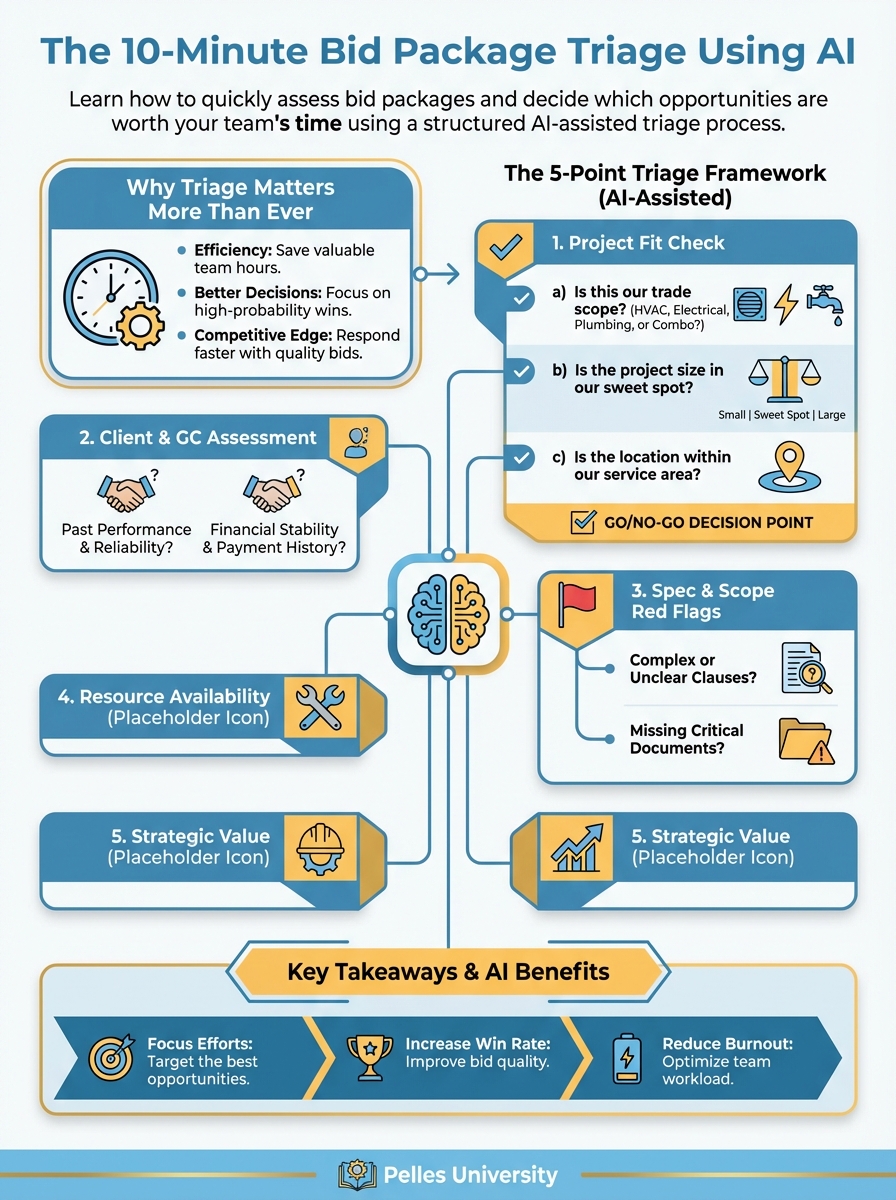
Your estimating team is buried. Every week brings a stack of ITBs, and you know half of them aren't worth the effort. The problem isn't finding opportunities—it's knowing which ones to chase.
A structured triage process, assisted by AI, can cut your initial review time from hours to minutes. Here's how to build one.
Why Triage Matters More Than Ever
Most MEP subs operate with the same estimating capacity they had five years ago, but bid volume has doubled. Without a filter, your best estimators waste time on projects you'll never win—or worse, on jobs that would hurt you to win.
The goal of triage isn't to do a full takeoff. It's to answer one question: Should this bid get our full attention?
That decision should take 10 minutes, not 10 hours. But precise triage makes that speed possible.
The 5-Point Triage Framework
Before opening a single drawing, run through these five filters:
1. Project Fit Check
- Is this our trade scope? (HVAC, electrical, plumbing, or combo?)
- Is the project size in our sweet spot?
- Is the location within our service area?
- Do we have capacity for the timeline?
If you hit two "no" answers, stop here.
2. Client & GC Assessment
- Have we worked with this GC before?
- What's their payment history?
- Is this a negotiated job or hard bid?
- Who else is likely bidding?
Example: An electrical sub received an ITB from a GC they'd never worked with. A quick check revealed three outstanding lawsuits with other subs. They passed—and avoided a nightmare.
3. Spec & Scope Red Flags
This is where AI shines. Feed the spec sections into an AI tool and ask:
- Are there performance specs vs. prescriptive specs?
- Any owner-furnished equipment we need to coordinate?
- Unusual warranty requirements?
- Commissioning or testing requirements beyond standard?
Flag anything that adds risk or scope you might miss in a fast review.
4. Timeline Reality Check
- When is bid due?
- When is project start?
- What's the construction duration?
- Are there phasing requirements?
If the timeline is impossibly tight, either the GC is desperate or someone else already has the inside track.
5. Commercial Terms Scan
Even before the formal contract review:
- What's the retainage?
- Any unusual payment terms?
- Bonding requirements?
- Insurance requirements above your standard coverage?
Setting Up AI-Assisted Triage
You don't need a fancy system. Here's a practical workflow:
-
Create a triage prompt template. Include the five categories above and the specific questions you want answered.
-
Feed in key documents. Start with the invitation letter, scope narrative, and Division 01. Add relevant spec sections for your trade.
-
Get a structured summary. Ask for a go/no-go recommendation with supporting reasons.
-
Human review. Senior estimator spends 5 minutes reviewing the AI output and makes the call.
The AI does the reading. Your estimator does the thinking.
Common Triage Mistakes
Mistake #1: Skipping triage due to workload. It's a common trap: skipping triage because you're busy, which keeps you busy on the wrong things. Every hour spent on a bad-fit bid is an hour stolen from a winnable one.
Mistake #2: Letting junior staff make go/no-go calls. Triage requires judgment. AI can surface the data, but the decision needs experience behind it.
Mistake #3: Not tracking your hit rate by project type. If you're winning 5% of healthcare jobs and 25% of education jobs, that should inform your triage.
Building Your Triage Scorecard
Create a simple scoring system:
| Factor | Weight | Score (1-5) |
|---|---|---|
| Project fit | 25% | __ |
| GC relationship | 20% | __ |
| Scope clarity | 20% | __ |
| Timeline feasibility | 15% | __ |
| Commercial terms | 20% | __ |
Use 3.0 as a baseline. Under 3.0? Highly likely to pass. Above 3.5? Strong pursuit. But always trust your strategic experience over the raw number.
Adjust weights based on what matters most to your shop.
What's Next
Once you've built triage into your weekly rhythm, the next step is automating the data extraction. The goal is getting from "ITB received" to "scored and decided" without anyone manually reading 200 pages of specs.
Start with one estimator, one week, and track what you catch that you would have missed.
TL;DR
-
Triage is a quick filter, not a full review—aim for 10 minutes
-
Use a 5-point framework: project fit, GC assessment, scope flags, timeline, and commercial terms
-
AI handles the document reading; your estimator handles the judgment call
-
Track your win rates by project type to improve your triage over time
-
A bad-fit bid you skip is capacity freed for a winnable one