Base bid is straightforward. You price the scope and submit a number. But alternates, allowances, and unit prices? That's where jobs are won and lost—and where most estimators spend the least time.
These line items deserve more attention. Here's how to price them right.
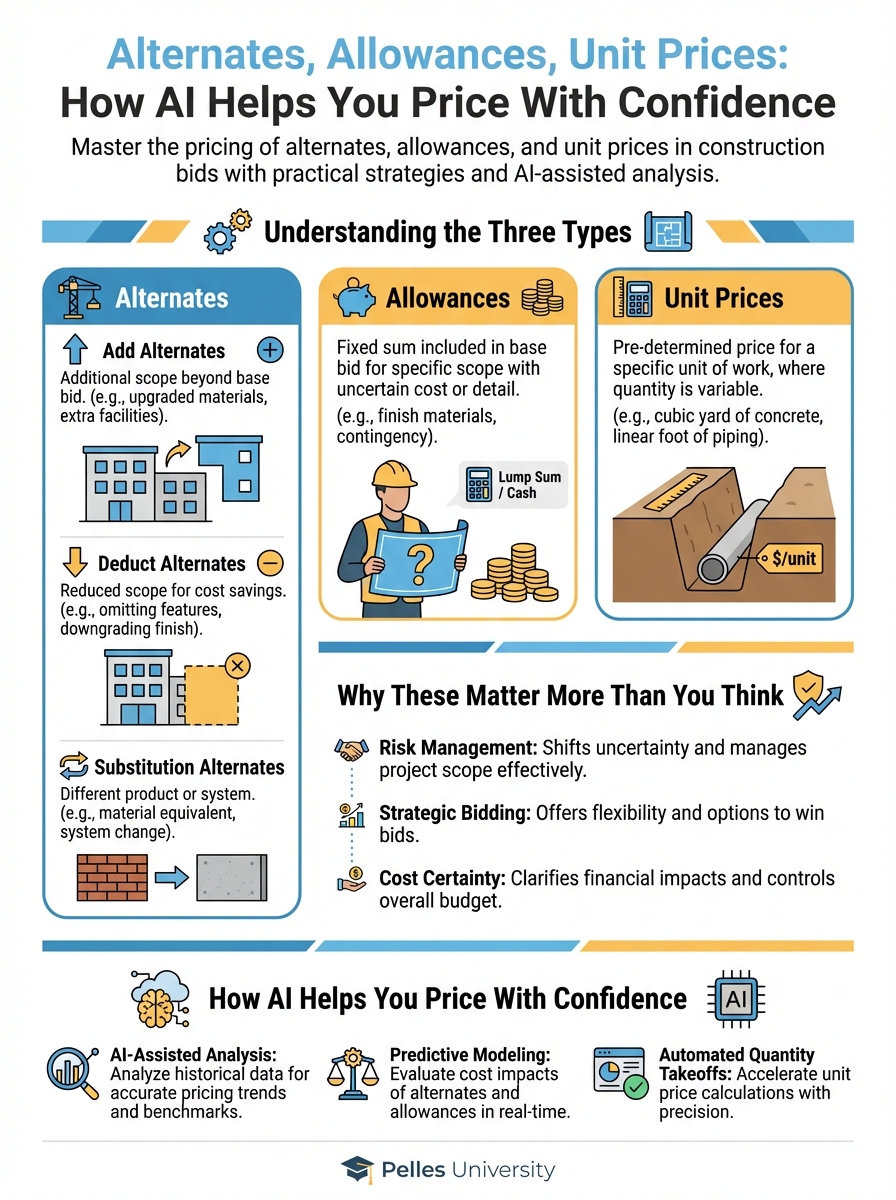
Understanding the Three Types
Alternates
The owner wants to know: "What if we do X instead of Y?" or "What does it cost to add Z?"
Alternates can be:
- Add alternates – Additional scope beyond base bid
- Deduct alternates – Reduced scope for cost savings
- Substitution alternates – Different product or system
Allowances
A placeholder amount included in your bid for undefined scope. The owner acknowledges uncertainty and asks you to carry a set dollar amount.
Common allowances:
- Equipment not yet selected
- Site conditions to be verified
- Specialty items TBD by owner
Unit Prices
Pre-agreed rates for work that may or may not happen. Used for change order pricing or when quantities are uncertain.
Common unit prices:
- Linear foot of additional piping
- Each additional outlet
- Per-ton of additional cooling capacity
Why These Matter More Than You Think
For the GC and owner: Alternates and unit prices are comparison tools. If your base bid is $5,000 higher but your add alternate is $10,000 lower, you might win.
For you: These are also negotiation leverage. A well-priced unit price protects your margin on change orders. A poorly priced one locks you into losing work.
Pricing Alternates Strategically
Rule 1: Price Alternates Like They'll Be Accepted
Some estimators sandbag alternates—padding add alternates or minimizing deduct alternates. This backfires. Owners compare alternate pricing across bidders. If your numbers don't make sense, they question your base bid too.
Rule 2: Track What's Included in Base
Before pricing an alternate, clearly define what's in your base bid that the alternate affects.
Example: An add alternate for generator backup on an HVAC system. If your base bid already includes electrical connections to the AHUs, does the alternate include rework? Or does the generator contractor handle all connections?
Document your assumptions. Put them in your qualifications.
Rule 3: Consider the Multiplier Effect
Alternates often have ripple effects:
- Add alternate for more equipment = more electrical, more commissioning, more warranty scope
- Deduct alternate for VRF instead of chilled water = different piping, different controls, different startup
Price the full impact, not just the obvious equipment delta.
Using AI for Alternate Analysis
Compare the base bid scope against Alternate #3.

For each system affected:
- What equipment changes?
- What labor changes?
- What coordination impacts exist?
- What commissioning or testing impacts?

Provide a checklist of cost impacts to review.
This surfaces the ripple effects you might miss in a rushed review.
Handling Allowances Correctly
The Allowance Trap
Here's how allowances go wrong:
- Owner includes $50,000 allowance for light fixtures
- You carry $50,000 in your bid
- Owner selects fixtures that cost $75,000 installed
- Owner expects you to eat the $25,000 difference
Why? Because your bid said "furnish and install light fixtures per spec." The allowance was for fixtures only—your labor was supposed to be in your base bid.
Protect Yourself
Clarify in your bid:
- What the allowance covers (material only? material and labor?)
- Who adjusts for overages (change order process?)
- What happens if scope changes (not just cost)?
Add this to your qualifications: "Allowance of $XX,XXX includes [materials only / materials and labor]. Allowance adjustment will be processed as a change order including [markup percentage]."
Tracking Allowances in Your Estimate
Create a separate allowance schedule:
| Allowance | Spec Reference | Amount | What It Covers | Notes |
|---|---|---|---|---|
| Light fixtures | 26 51 00 | $50,000 | Material only | Labor in base bid |
| Access controls | 28 10 00 | $30,000 | Material + labor | Undefined scope |
Review this schedule before bid submission. Make sure your team understands what's covered.
Setting Unit Prices That Protect Margin
The Unit Price Danger Zone
Unit prices lock in rates before you know:
- Actual quantities
- Site conditions
- Schedule impacts
- Whether work will be in occupied space
If you price unit rates like ideal conditions and the work happens in a congested ceiling during second shift, you lose money.
Pricing Unit Rates Right
Step 1: Price for realistic conditions, not best case
Step 2: Include full burden—not just labor and material
- Overhead
- Mobilization (if work is scattered)
- Coordination time
- Markup
Step 3: Add a minimum quantity or minimum charge
- "Unit price applies for quantities over 10. For quantities under 10, minimum charge of $500 applies."
Step 4: Define what's included
- "Linear foot price includes pipe, hangers, insulation, and testing. Does not include penetrations, fire stopping, or painting."
Common Unit Price Items for MEP
| Item | What to Include in Rate |
|---|---|
| LF of pipe | Material, labor, hangers, fittings pro-rated, testing |
| EA device/outlet | Device, box, termination, testing |
| Per ton capacity | Equipment delta, piping impact, electrical impact |
| EA fire alarm device | Device, wire home run, programming, testing |
What's Next
Alternates, allowances, and unit prices deserve the same rigor as your base bid. The next step is building templates for common scenarios—so your team isn't reinventing pricing logic on every bid.
TL;DR
- Alternates, allowances, and unit prices are where bids are won or lost—don't rush them
- Price alternates like they'll be accepted; include all ripple effects
- Clarify what allowances cover—material only vs. material + labor
- Unit prices should reflect realistic conditions with full burden and minimums
- Use AI to surface the full scope impact of alternates you might otherwise miss