Change order submitted. Response: "Provide additional backup."
That phrase has killed more margins than bad estimates. Not because the change wasn't valid—but because the documentation didn't prove it.
Here's how to build change orders that get approved.
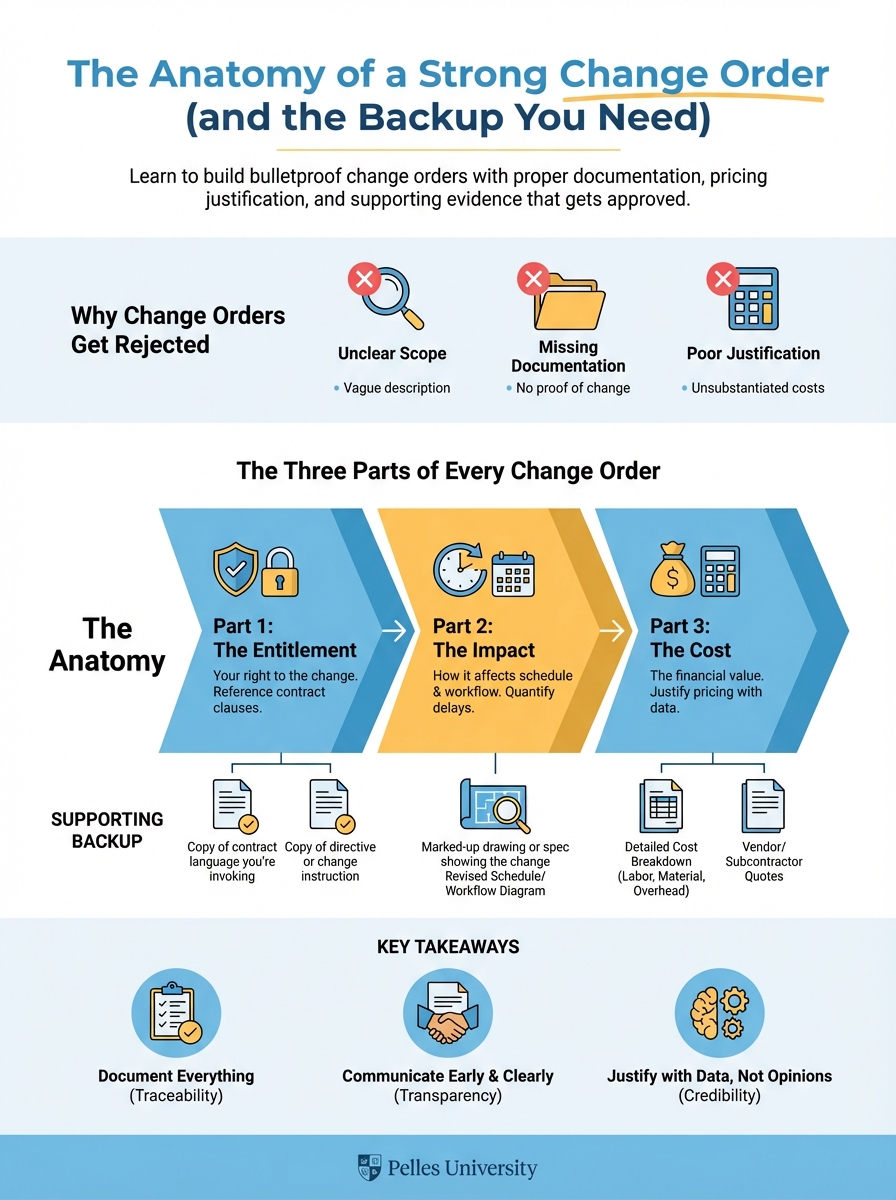
Why Change Orders Get Rejected
"Already in your scope" – You didn't prove the work is outside the contract.
"Price is too high" – You didn't justify the hours and materials.
"Provide additional backup" – Your documentation was incomplete.
"We didn't direct this work" – You can't prove authorization.
Every rejection is a documentation failure. The work was probably valid—the paper wasn't.
The Three Parts of Every Change Order
Part 1: The Entitlement
Why are you owed additional compensation? This establishes the legal/contractual basis.
Part 2: The Impact
What extra work was performed? This describes the scope of the change.
Part 3: The Cost
What does the additional work cost? This justifies the dollar amount.
Weak change orders fail on at least one of these. Strong change orders nail all three.
Part 1: Proving Entitlement
Entitlement comes from contract language. Common bases:
Changed conditions: "Section 7.2.1 provides for adjustment when conditions differ materially from those indicated in the Contract Documents."
Owner-directed change: "Per GC directive dated [date], we were instructed to [description]."
Design error or omission: "Drawing M-201 does not show ductwork routing through the existing chase. Field conditions require alternate routing as attached."
Out-of-scope work: "Specification Section 23 73 00 requires equipment A. GC directive of [date] requires equipment B instead. Equipment B requires additional supports, electrical, and commissioning."
The Entitlement Backup
- Copy of contract language you're invoking
- Copy of directive or change instruction
- Marked-up drawing or spec showing the change
- Photos of field conditions (for field-discovered issues)
- RFI response directing the change (if applicable)
Part 2: Documenting Impact
Describe exactly what changed. Be specific about:
Before: What was in the original scope After: What was required by the change Delta: The difference you're claiming
Example: "Original contract included installation of 2" copper piping from mechanical room to penthouse per drawing P-101, Route A (150 LF). RFI-023 response directed routing per Route B (210 LF) due to structural conflict. Additional scope: 60 LF of 2" copper with associated hangers, fittings, insulation, and pressure testing."
The Impact Backup
- Marked-up drawings showing before and after
- Annotated photos
- Quantity comparison (original vs. revised)
- Scope comparison narrative
Part 3: Justifying Cost
This is where most change orders fall apart. Your pricing must be:
Transparent: Show the math Supported: Attach backup for rates and quantities Reasonable: Align with contract terms and industry norms
The Cost Breakdown
| Item | Qty | Unit | Rate | Total |
|---|---|---|---|---|
| 2" Copper pipe | 60 | LF | $XX.XX | $XXX |
| Fittings (assorted) | 12 | EA | $XX.XX | $XXX |
| Hangers | 20 | EA | $XX.XX | $XXX |
| Insulation | 60 | LF | $XX.XX | $XXX |
| Labor - Journeyman | 24 | HR | $XX.XX | $XXX |
| Labor - Apprentice | 16 | HR | $XX.XX | $XXX |
| Subtotal | $X,XXX | |||
| Overhead (per contract %) | $XXX | |||
| Profit (per contract %) | $XXX | |||
| Total | $X,XXX |
The Cost Backup
- Material quotes or invoices
- Labor rate documentation (contract rates or union scale)
- Equipment rental receipts (if applicable)
- Subcontractor quotes
- Overhead and profit percentage per contract
The Complete Change Order Package
Assemble in this order:
1. Cover letter Summary of change, total amount, contract reference for adjustment
2. Change order request form Standard format with signatures
3. Entitlement documentation Directive, RFI, contract language
4. Impact documentation Marked-up drawings, before/after comparison
5. Cost documentation Detailed breakdown with backup
6. Supporting documents Photos, submittals, correspondence
Getting Work Authorized Before You Do It
The best change order is one authorized in advance.
Step 1: Identify potential change Step 2: Notify GC in writing before proceeding Step 3: Request written direction to proceed Step 4: Document any verbal authorization Step 5: Perform work only with authorization Step 6: Submit change order with reference to authorization
Example notification: "We have identified that [condition/issue] requires additional work not included in our contract scope. Estimated additional cost is $X,XXX. Please provide written direction to proceed. We will hold this work until we receive authorization."
When You're Directed to Proceed Without Pricing
Sometimes the GC says "do the work, we'll sort out the money later."
Protect yourself:
- Document the directive in writing
- Proceed on a T&M basis
- Track all hours and materials daily
- Submit weekly T&M tickets for signature
- Submit change order as soon as work is complete
T&M tracking essentials:
- Daily labor tickets with names, hours, task description
- Material receipts with quantity and price
- Equipment logs if applicable
- Daily photos of work progress
Using AI to Build Change Order Narratives
Once you have your backup documents:
Help me write a change order narrative for:

Contract: [Project name, contract number]
Directive: [Describe the change directive]
Original scope: [What was in the contract]
Changed scope: [What was directed]
Impact: [Additional work performed]
Cost: [Dollar amount with breakdown]

The narrative should:
1. Establish entitlement (reference contract clause)
2. Describe the impact clearly
3. Justify the cost
4. Request approval

Keep it professional and factual.
Common Change Order Mistakes
Mistake 1: Waiting Too Long
Submit change orders promptly. Stale changes are harder to prove and easier to reject.
Mistake 2: Bundling Multiple Changes
One issue per change order. Bundling causes partial rejections and confusion.
Mistake 3: No Contemporaneous Documentation
Photos and notes taken months later don't carry the same weight as same-day documentation.
Mistake 4: Lump-Sum Pricing Without Backup
"$15,000 for additional work" isn't documentation. Break it down.
Mistake 5: Not Referencing Contract Terms
If your contract specifies markup rates or change order procedures, follow them exactly.
What's Next
Strong change order documentation is defensive. The proactive version is tracking potential changes as they emerge—so you're always ahead of the paperwork instead of scrambling to reconstruct events.
TL;DR
- Every change order needs three parts: entitlement (why you're owed), impact (what changed), cost (how much)
- Back up each part: contract language, marked-up drawings, detailed cost breakdowns
- Get authorization before doing changed work—written directive beats verbal every time
- Track T&M daily if working without approved pricing
- One issue per change order, submitted promptly with complete documentation