You won the job. Now what?
The handoff from estimating to project management is where jobs go wrong before they start. Assumptions get lost. Clarifications get forgotten. Exclusions never make it to the PM.
A structured turnover process prevents the chaos.
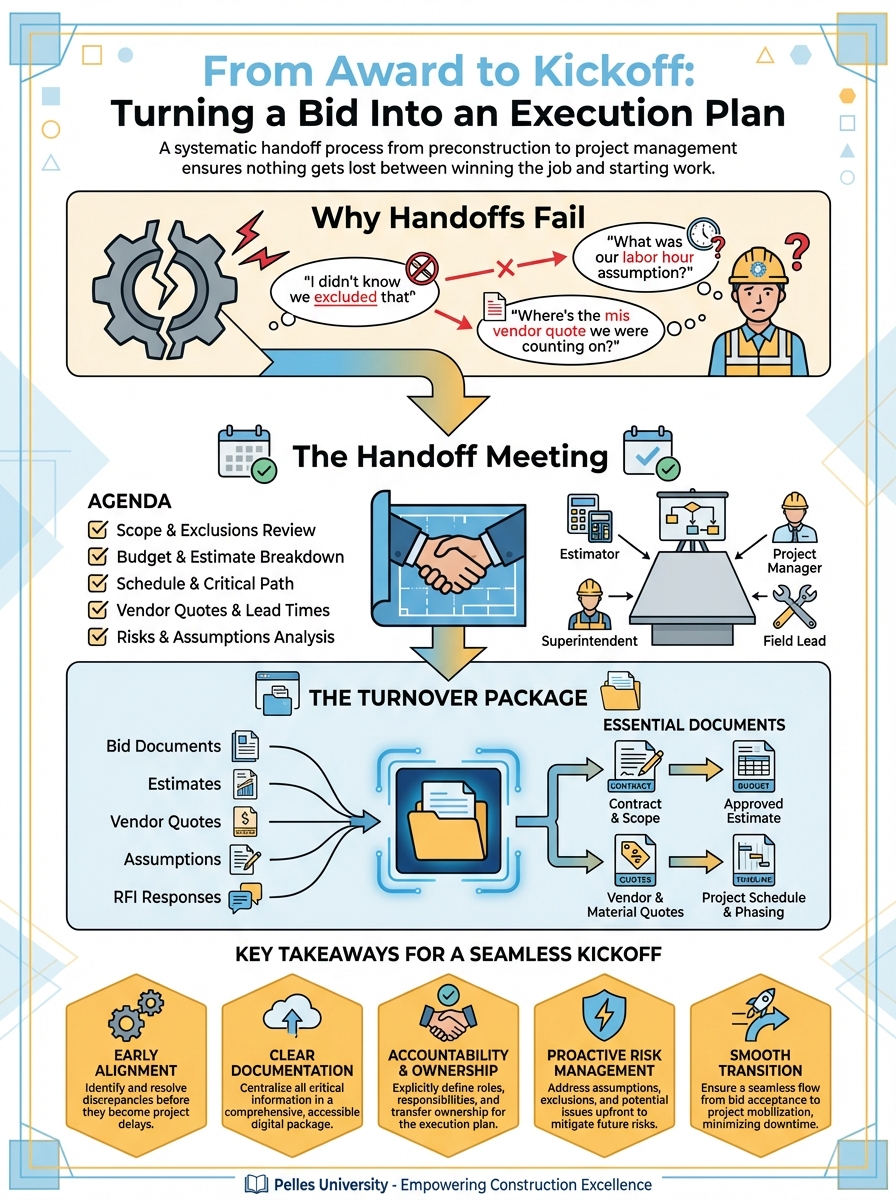
Why Handoffs Fail
The symptoms are always the same:
- "I didn't know we excluded that"
- "Where's the vendor quote we were counting on?"
- "What was our labor hour assumption?"
- "Did anyone get the spec clarification in writing?"
The cause: verbal handoffs and email chains instead of structured turnover.
The Handoff Meeting
Every project needs a formal handoff meeting before the PM takes over.
Attendees:
- Estimator who bid the job
- Assigned project manager
- Operations/senior management (for larger jobs)
Duration: 30-60 minutes depending on job size
Output: Documented turnover package and action items
Agenda
1. Project Overview (5 min)
- Owner and GC
- Contract value and margin
- Key dates: start, milestones, completion
2. Scope Review (15 min)
- Major systems and equipment
- What's included (reference estimate breakdown)
- What's excluded (this is critical)
- Clarifications and assumptions
3. Budget Walkthrough (10 min)
- Labor hour budget by phase
- Major equipment and when quotes expire
- Subcontractor scope and pricing
- Contingency or risk allowance
4. Risk Discussion (10 min)
- What kept the estimator up at night?
- Contract terms that need attention
- GC relationship history
- Schedule risks
5. Immediate Actions (10 min)
- Submittals due
- Long-lead equipment to order
- Subcontracts to execute
- RFIs in progress
The Turnover Package
Paper (or files) that transfer with the job:
Essential Documents
Contract package:
- Executed subcontract
- All addenda and modifications
- Bond and insurance certificates
Estimate package:
- Summary estimate with labor hours
- Detailed takeoff (if digital, file location)
- Vendor and sub quotes
- Assumptions log
Bid documents:
- Final bid form submitted
- Inclusions/exclusions list
- Clarification letter
- Any RFI responses received
Project documents:
- Latest drawings (with revision log)
- Specifications (your divisions)
- Equipment schedules
- General conditions/Division 01
The Turnover Summary Sheet
One page that captures the essentials:
PROJECT TURNOVER SUMMARY

Project: [Name]
Contract Value: $[Amount]
Estimated Margin: [%]

KEY DATES:
- Contract signed: [Date]
- Mobilization: [Date]
- Substantial completion: [Date]

LABOR BUDGET:
- Total hours: [X]
- Rough-in: [X hours]
- Trim-out: [X hours]
- Startup/commissioning: [X hours]

MAJOR EQUIPMENT:
- [Item 1]: $[Cost] - Quote valid until [Date]
- [Item 2]: $[Cost] - Quote valid until [Date]

SUBCONTRACTORS:
- [Trade]: [Company] - $[Amount]
- [Trade]: [Company] - $[Amount]

CRITICAL EXCLUSIONS:
- [Exclusion 1]
- [Exclusion 2]
- [Exclusion 3]

BUDGET RISKS:
- [Risk 1]: [Contingency amount or note]
- [Risk 2]: [Contingency amount or note]

OPEN ITEMS:
- [RFI or question pending]
- [Decision needed]

Estimator: [Name] / [Date]
PM Received: [Name] / [Date]
Common Handoff Failures
Failure 1: The "Same as Last Time" Assumption
PM assumes scope is the same as a similar past project. It's not. Every job has unique exclusions and clarifications.
Prevention: Review inclusions/exclusions specifically, even if the project type is familiar.
Failure 2: The Expired Quote
Equipment quote was valid for 30 days. Handoff happened on day 45. Price has changed.
Prevention: Turnover summary lists quote validity dates. PM extends or re-quotes immediately.
Failure 3: The Missing RFI Response
Estimator got verbal clarification. Never documented. PM assumes something different.
Prevention: All bid-phase clarifications documented in writing before handoff.
Failure 4: The Forgotten Risk
Estimator included contingency for a tricky condition. PM doesn't know it's there. Spends it on something else.
Prevention: Budget risks explicitly listed with dollar amounts tied to specific concerns.
Using AI to Build Turnover Docs
After award, use this prompt:
Based on this estimate and bid documents, create a project turnover summary including:

1. Key dates and milestones
2. Labor budget breakdown by phase
3. Major equipment with costs and quote validity
4. Subcontractor scope and pricing
5. Critical exclusions from bid
6. Budget risks and contingencies
7. Open items requiring immediate action

Format as a one-page summary sheet.
Review and customize—AI doesn't know your specific conversations and assumptions.
The Kickoff with the GC
After internal handoff, you'll have a GC kickoff meeting. Be prepared with:
- Questions about schedule and phasing
- Long-lead item release timeline
- Submittal priorities
- Coordination meeting schedule
- Site logistics (laydown, parking, access)
Your internal handoff prepares you to have this conversation without fumbling.
Building This Into Your Process
Day 1 after award: Schedule handoff meeting Within 5 business days: Complete turnover meeting and documentation Within 10 business days: PM has all files, open items actioned
Don't let awarded jobs sit. The longer between award and kickoff, the more gets lost.
What's Next
A good handoff sets up the PM for success. The next step is building project dashboards that track budget, schedule, and open items—so the turnover data stays visible throughout the job, not just at kickoff.
TL;DR
- The bid-to-PM handoff is where jobs go wrong before they start—structure it
- Hold a formal turnover meeting with estimator, PM, and ops leadership
- Create a turnover package: contract, estimate, bid documents, and project documents
- Use a one-page turnover summary with labor, equipment, exclusions, and risks
- Complete handoff within 5-10 days of award—don't let jobs sit