You did extra work. You have documentation. Now you need to get paid.
Change order negotiation is where many subcontractors leave money on the table—either by accepting too little or by damaging relationships that cost them future work. Here's how to negotiate effectively.
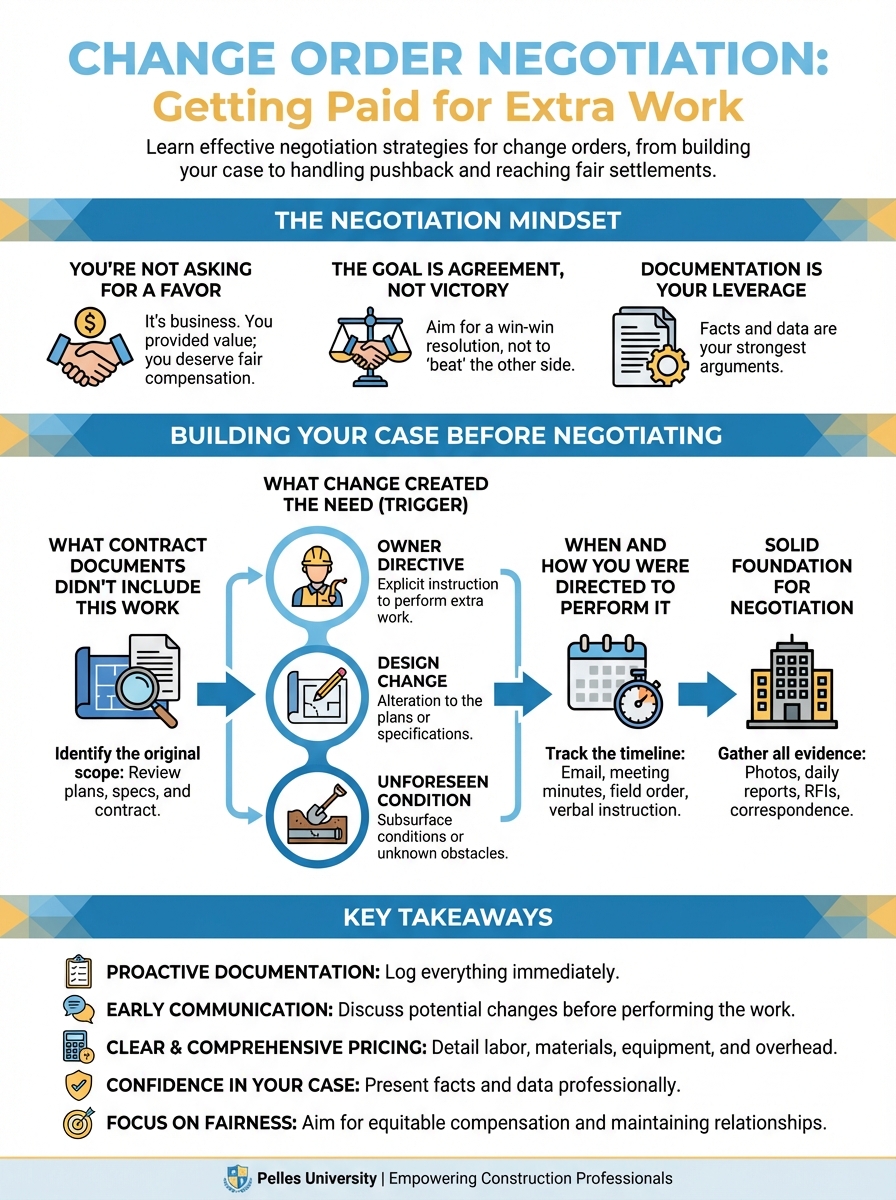
The Negotiation Mindset
You're Not Asking for a Favor
Extra work is a business transaction. You performed services; you're owed compensation. Approach negotiations as a professional seeking fair payment, not a supplicant hoping for charity.
The Goal Is Agreement, Not Victory
A negotiation that gets you paid and preserves the relationship is better than one that maximizes dollars but burns bridges. Most of your work comes from repeat clients—protect those relationships.
Documentation Is Your Leverage
The strength of your negotiating position depends on your documentation. If you can prove entitlement, impact, and cost, you negotiate from strength. If you're relying on "trust me," you're negotiating from weakness.
Building Your Case Before Negotiating
Establish Entitlement
Before you can negotiate price, establish that the work is extra:
The baseline question: Is this work clearly required by the original contract documents—drawings, specifications, and scope of work?
If yes, it's base contract work. If no or unclear, you have an entitlement argument.
Document the basis:
- What contract documents didn't include this work
- What change (owner directive, design change, unforeseen condition) created the need
- When and how you were directed to perform it
Document the Impact
Show what the change required:
- Additional labor hours (detailed breakdown)
- Additional materials (quantities and costs)
- Equipment or rentals needed
- Schedule impact
- Productivity impact on base work
- Overhead and markup
Calculate the Cost
Build your pricing from documented inputs:
| Cost Element | Amount | Backup |
|---|---|---|
| Labor (X hours @ $Y) | $Z | Time sheets |
| Materials | $Z | Invoices |
| Equipment | $Z | Rental receipts |
| Subcontractor | $Z | Sub quotes |
| Overhead | $Z | Per contract % |
| Profit | $Z | Per contract % |
| Total | $Z |
Your number should be defensible, not just hopeful.
Negotiation Strategies
Strategy 1: Anchor High (But Reasonably)
Your opening position matters. Starting at $50,000 and settling at $40,000 is different from starting at $40,000 and settling at $32,000.
Anchor with:
- Your fully burdened cost
- Reasonable markup per contract
- Documented backup for every element
Don't anchor with:
- Inflated numbers you can't justify
- Round numbers without backup
- "What you think you can get"
Strategy 2: Lead with Documentation
When presenting your change:
"Here's the change order request for $43,500. The package includes:
- The RFI response that directed the change
- Detailed labor breakdown showing 120 hours
- Material invoices totaling $12,400
- Photos of the condition and work performed
I'm happy to walk through any of it."
Documentation signals you're prepared and makes arbitrary rejections harder.
Strategy 3: Separate Issues
When negotiations stall, separate the issues:
- Do they agree the work is extra? (Entitlement)
- Do they agree on what was done? (Impact)
- Are they disputing the cost? (Pricing)
Resolve issues one at a time. Often the real dispute is narrow.
Strategy 4: Understand Their Constraints
GCs and owners operate within systems:
- They may need approvals for amounts over certain thresholds
- They may have budget constraints
- They may face pressure from their clients
Understanding their position helps you find solutions that work for both parties.
Handling Common Pushback
"That's included in your scope"
Response: "Help me understand where. I've reviewed Division [X] and Section [Y]. Can you point me to the specific requirement?"
Put the burden on them to justify their position with contract language.
"That's not what we directed"
Response: "I have the RFI response dated [date] and the email from [name] on [date] directing this approach. Let me share those again."
Documentation defeats revisionist history.
"Your price is too high"
Response: "I'm happy to review the breakdown together. Which elements do you see differently?"
Make them engage with specifics rather than blanket rejection.
"We don't have budget for that"
Response: "I understand budget is a concern. This work was performed and costs were incurred. How can we work together to get this resolved?"
Their budget problem isn't your problem—but being solution-oriented helps.
"Just eat it this time"
Response: "I value our relationship, and I want to find fair resolutions. But I also can't absorb [scope of extra work] without compensation. What's your proposal for getting this worked out?"
Acknowledge the relationship while holding your ground.
When to Compromise
Not every change order is worth fighting to the last dollar.
Consider Compromise When:
- The relationship is valuable and ongoing
- The disputed amount is small relative to the overall project
- Your documentation has gaps that weaken your position
- Resolution now prevents larger disputes later
How to Compromise Effectively:
- Know your floor: What's the minimum you can accept?
- Get something in return: "I can do $38,000 if we can resolve this today."
- Document the settlement: Written agreement on final amount
- Don't establish bad patterns: One compromise doesn't mean always compromising
Escalation Paths
When negotiation fails:
Level 1: GC Project Manager
Most negotiations happen here. Document all positions.
Level 2: GC Senior Management
If the PM won't move, escalate professionally: "I'd like to discuss this with [senior person]. We're at an impasse and I want to make sure leadership is aware."
Level 3: Owner Involvement
If the GC is the bottleneck, contract may allow direct owner communication. Use carefully—GCs don't like being bypassed.
Level 4: Formal Dispute Process
Mediation, arbitration, or litigation. Expensive and relationship-ending. Use only when other options fail and amounts justify it.
Using AI for Negotiation Prep
AI can help organize your case:
I have a change order dispute for relocated sprinkler work.
- Original scope: Drawing FP-201 showed heads in locations A, B, C
- Change: ASI #14 moved heads to locations X, Y, Z
- Impact: 40 additional labor hours, $2,100 materials

Help me:
1. Summarize the entitlement argument
2. Create a talking points list for negotiation
3. Anticipate likely counterarguments and responses
Post-Negotiation
Document the Agreement
After reaching settlement:
- Get written confirmation of agreed amount
- Update change order log
- Submit formal CO for execution
- Track payment
Learn from the Process
What worked? What didn't? Document lessons for future negotiations.
Maintain the Relationship
Win or lose, you may work with these people again. Be professional throughout.
What's Next
Successful negotiation depends on recognizing extra work early. Next, learn to identify change order situations before they become disputes—protecting your interests from day one.
TL;DR
- Documentation is your leverage—you can't negotiate without it
- Anchor high but reasonable; opening position influences outcome
- Separate issues: entitlement, impact, and cost may have different objections
- Respond to pushback with questions and documentation, not arguments
- Know when to compromise—relationships sometimes exceed dollars
- Document settlements in writing
- Be professional throughout; you'll likely work together again