Your subcontract is 30 pages. The prime contract is 200 pages. And buried in your subcontract is a sentence that makes you responsible for both.
That's how flow-down clauses work. And that's how subcontractors inherit obligations they never knew existed.
What Flow-Down Means
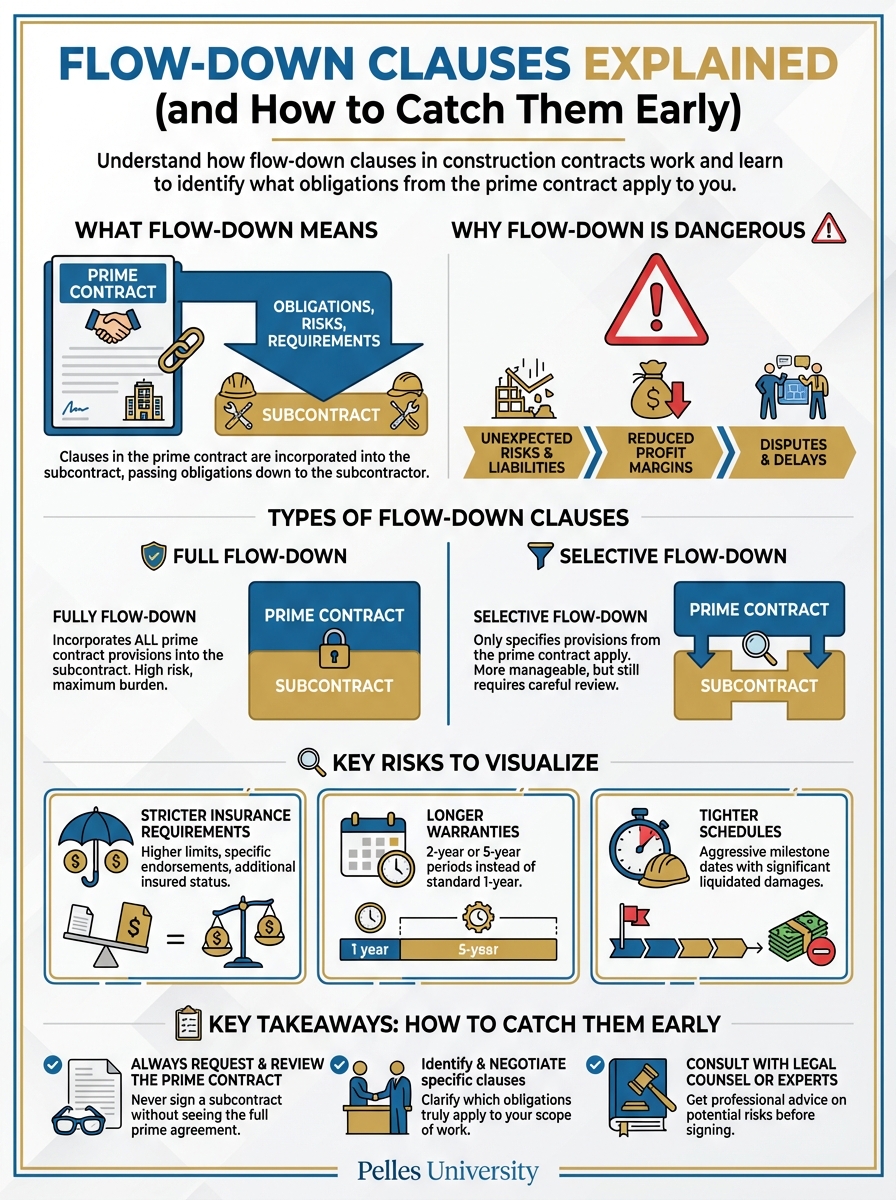
A flow-down clause makes the terms of the prime contract (between GC and owner) binding on your subcontract. The language usually looks something like:
"Subcontractor shall be bound to Contractor by the terms of the Contract Documents and assumes toward Contractor all obligations and responsibilities that Contractor assumes toward Owner."
Translation: Whatever the GC promised the owner, you're now promising the GC—even if you've never seen the prime contract.
Why Flow-Down Is Dangerous
The prime contract often contains terms more onerous than your subcontract:
- Stricter insurance requirements – Higher limits, specific endorsements
- Longer warranties – 2-year or 5-year instead of 1-year
- Tighter schedules – Milestone dates with liquidated damages
- Broader indemnification – Coverage beyond your negligence
- Owner-specific requirements – Security, badging, compliance programs
You won't know these exist unless you request and review the prime contract.
Example: A mechanical sub signed a contract with standard terms. The flow-down clause incorporated the prime contract, which required 5-year warranty on equipment instead of the standard 1-year. They discovered this at closeout when the GC demanded warranty documentation for year 5.
Types of Flow-Down Clauses
Full Flow-Down
All terms of the prime contract apply. Most aggressive form.
"The terms and conditions of the Prime Contract are hereby incorporated by reference as though fully set forth herein."
Selective Flow-Down
Only specified sections apply. More reasonable, but you need to read those sections.
"The following sections of the Prime Contract apply to Subcontractor's work: Article 4 (Schedule), Article 7 (Changes), Article 11 (Insurance), and Article 12 (Dispute Resolution)."
Functional Flow-Down
You assume obligations for your scope only. Most reasonable.
"Subcontractor shall comply with the Prime Contract to the extent applicable to Subcontractor's scope of work."
Back-to-Back Flow-Down
You assume the same relationship to GC that GC has to owner.
"Subcontractor's obligations to Contractor shall be identical to Contractor's obligations to Owner under the Prime Contract."
How to Handle Flow-Down
Step 1: Identify the Flow-Down Language
Search your subcontract for:
- "incorporated by reference"
- "bound by the terms"
- "assumes toward Contractor"
- "prime contract"
- "general contract"
- "contract documents"
Mark every instance. There may be multiple flow-down provisions.
Step 2: Request the Prime Contract
If the subcontract references the prime contract, you have a right to see it. Ask for:
- The prime contract itself (or relevant articles)
- General conditions
- Any supplementary conditions
- Owner-specific requirements
If the GC won't provide it, that's a red flag.
Step 3: Review Key Sections
Focus on sections most likely to contain problematic terms:
- Insurance and indemnification
- Schedule and liquidated damages
- Changes and claims
- Warranty
- Dispute resolution
- Owner-specific requirements
Step 4: Document What You're Accepting
Make a list of obligations flowing down that affect your work:
| Prime Contract Term | Impact | Action |
|---|---|---|
| 5-year equipment warranty | Cost increase | Price in estimate |
| 4-hour emergency response | Labor impact | Clarify terms |
| Security badge requirement | Coordination | Note in schedule |
Step 5: Negotiate or Clarify
For unreasonable flow-down terms:
Option A: Request limitation of flow-down to specific sections.
Option B: Request exception for specific terms that don't apply to your scope.
Option C: Price the additional obligations into your bid (if not already).
Using AI to Identify Flow-Down Impacts
When you receive both subcontract and prime contract:
Compare these two contracts:

SUBCONTRACT:
[Paste subcontract text]

PRIME CONTRACT:
[Paste prime contract text]

Identify:
1. Flow-down clauses in the subcontract
2. Prime contract terms that flow down
3. Obligations in prime contract that exceed standard subcontract terms
4. Specific sections that increase risk for the subcontractor

For each finding, explain the practical impact.
This gives you a roadmap for negotiation or pricing adjustments.
Common Flow-Down Traps
Trap 1: The Invisible Warranty
Prime contract requires 2-year warranty; your subcontract mentions warranty only by flow-down reference. You think you have 1-year.
Prevention: Always request warranty terms in writing.
Trap 2: The Schedule Cascade
Prime contract liquidated damages: $5,000/day. Flow-down makes you responsible for your portion of delays—but "portion" isn't defined.
Prevention: Clarify how delay damages are allocated.
Trap 3: The Insurance Gap
Prime contract requires $5M umbrella coverage. Your subcontract doesn't list specific limits—but flow-down incorporates the prime.
Prevention: Compare insurance requirements before signing.
Trap 4: The Perpetual Claim
Prime contract has different claim notice periods than your subcontract. Flow-down creates ambiguity about which applies.
Prevention: Get explicit clarification on notice requirements.
What's Next
Understanding flow-down is defensive. The offensive move is building flow-down review into your standard contract process—so you catch these issues before signing, not after.
TL;DR
- Flow-down clauses make prime contract terms binding on your subcontract—even if you've never seen them
- Types range from full flow-down (everything) to functional flow-down (your scope only)
- Always request and review the prime contract before signing a subcontract with flow-down language
- Focus on insurance, warranty, schedule, and indemnification sections
- Document what you're accepting and negotiate exceptions for unreasonable terms