Every estimator has a story about the requirement they missed. The one buried on page 47 of the specs. The one that cost $30,000 they didn't have in the bid.
The good news: most "gotchas" are predictable. They show up in the same places, project after project. Once you know where to look, you can train AI to flag them automatically.
Here's the checklist.
Division 01 Gotchas
Division 01 is where owners hide requirements that apply to everyone—including you.
Flag These Every Time:
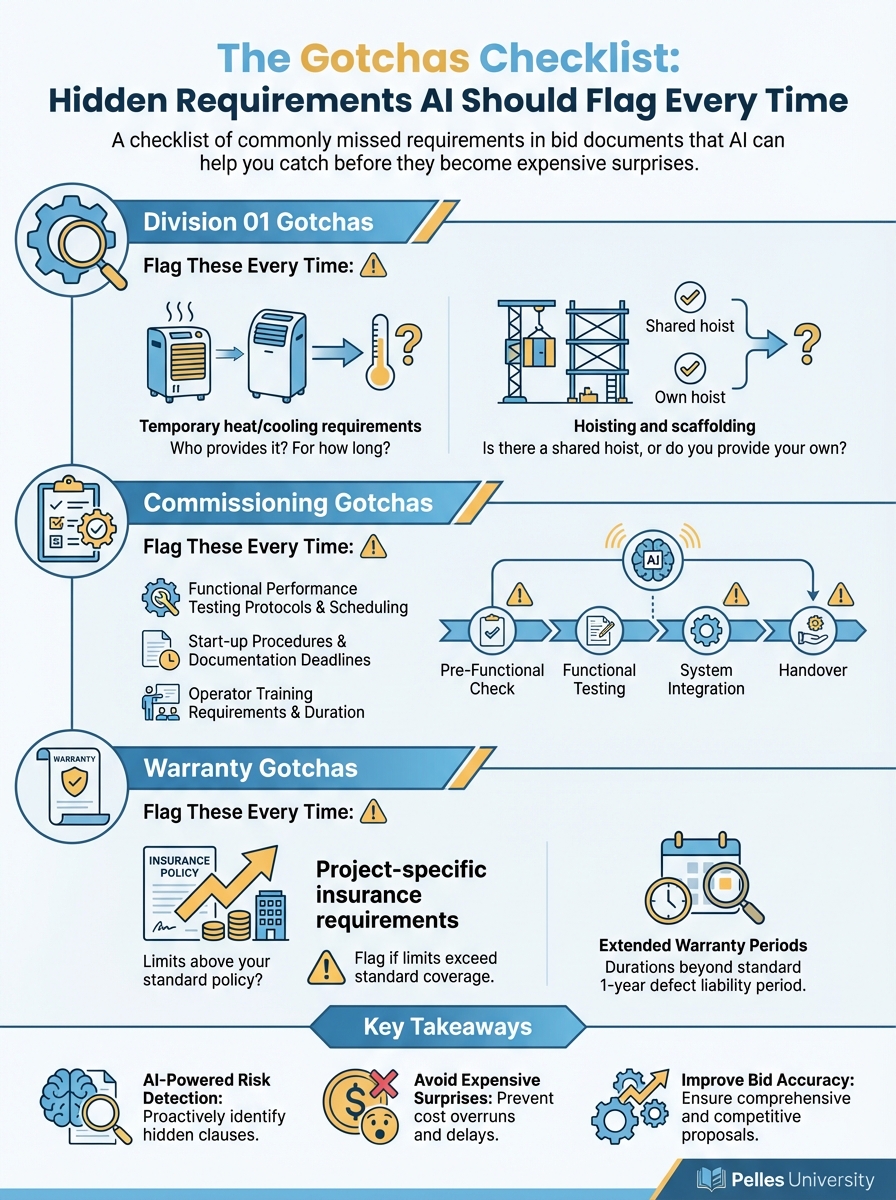
- Temporary heat/cooling requirements – Who provides it? For how long?
- Hoisting and scaffolding – Is there a shared hoist, or do you provide your own?
- Project-specific insurance requirements – Limits above your standard policy?
- Liquidated damages – Amount per day and conditions
- Working hours restrictions – Overtime requirements for occupied buildings
- Security requirements – Badging, background checks, escorts
- Cleanup requirements – Daily cleanup, final cleanup, dumpster fees
- Protection of existing work – Who's responsible for damage?
- Submittals timeline – Unusually aggressive schedules
Example: A mechanical contractor bid a hospital renovation without catching the requirement for 24/7 security escorts in patient areas. Every technician needed a hospital employee escort. Added $15,000 in coordination time they didn't price.
Commissioning Gotchas
Commissioning requirements have exploded in the last decade. These aren't optional.
Flag These Every Time:
- Commissioning authority involvement – Do you attend their meetings?
- Pre-functional checklists – Who provides templates? Who fills them out?
- Functional performance testing – How many hours of your labor?
- Seasonal testing – Do you come back for summer and winter tests?
- Trend logging requirements – How long? Who reviews?
- Training requirements – Formal training for owner's staff?
- O&M manual format – Specific software or format requirements?
If the spec says "commissioning per ASHRAE Guideline 0," that's a significant scope item. Don't bury it.
Warranty Gotchas
Standard warranty is one year. Except when it's not.
Flag These Every Time:
- Extended warranties – 2-year, 5-year, or "manufacturer's standard"
- Warranty start date – Substantial completion or beneficial occupancy?
- Parts and labor – Is labor included in the warranty period?
- Response time requirements – 24-hour, 4-hour, same-day
- Warranty bonds – Required for the extended period?
Example: An electrical sub assumed standard one-year warranty. The spec required five-year warranty on lighting controls with 4-hour response time. That's a service contract, not a warranty—and it wasn't in their price.
Coordination Gotchas
These are scope boundary issues that often fall through the cracks.
Flag These Every Time:
- BIM/coordination requirements – LOD requirements? Who hosts meetings?
- Sleeve and penetration responsibilities – Who provides, who installs?
- Fire stopping – By trade or by separate contractor?
- Electrical connections – Final connection by whom?
- Controls integration – Interface points, who commissions?
- Insulation – Factory-applied, field-applied, by whom?
- Painting and identification – Pipe labels, color coding
If the spec doesn't clearly assign responsibility, ask in an RFI. Don't assume.
Testing Gotchas
Testing requirements vary wildly and are easy to underestimate.
Flag These Every Time:
- Pressure testing – Duration, witnessed or unwitnessed?
- Air balance – Certified third party or self-performed?
- Electrical testing – Megger, infrared, arc flash studies?
- Pipe flushing and cleaning – Chemical treatment? Duration?
- Sound testing – NC levels, who measures?
- Vibration testing – Criteria and measurement method?
Substitution Gotchas
The specs say "or equal," but read the fine print.
Flag These Every Time:
- Substitution request deadline – Often 10 days before bid
- Required documentation – Some owners want full submittals with the request
- Approval process – Architect approval, owner approval, or both?
- No substitution specs – Some products are sole-source. No equals allowed.
- Basis of design penalties – Some specs reduce your price if you substitute
Building Your AI Flagging System
Create a prompt that checks for all of the above:
Review these bid documents and flag any of the following:

DIVISION 01:
- Temporary heating/cooling requirements
- Hoisting or scaffolding provisions
- Insurance requirements above standard
- Liquidated damages amounts
- Working hours restrictions
- Security or escort requirements
- Cleanup responsibilities
- Protection of existing work

COMMISSIONING:
- Commissioning agent coordination requirements
- Functional testing labor hours
- Seasonal testing requirements
- Training requirements
- O&M manual format requirements

WARRANTY:
- Warranty periods beyond one year
- Warranty start date triggers
- Response time requirements
- Warranty bond requirements

TESTING:
- Pressure test duration and witness requirements
- Third-party testing requirements
- Special testing (sound, vibration, thermal)

For each flag, provide:
- The requirement
- Where it appears (page/section)
- Why it matters (cost or risk impact)
Run this on every bid. Build your gotcha immunity.
What's Next
A checklist is only as good as your follow-through. The next step is building these flags into your estimating process—so every flagged item gets a line in your estimate or ends up on your exclusions list.
TL;DR
- Most expensive misses are predictable—they hide in the same places every time
- Division 01, commissioning, warranty, and testing sections are gotcha hotspots
- Train AI to flag these automatically so human review focuses on judgment calls
- If a spec doesn't clearly assign responsibility, ask via RFI—don't assume
- Every flagged item should end up priced, excluded, or clarified—no orphans