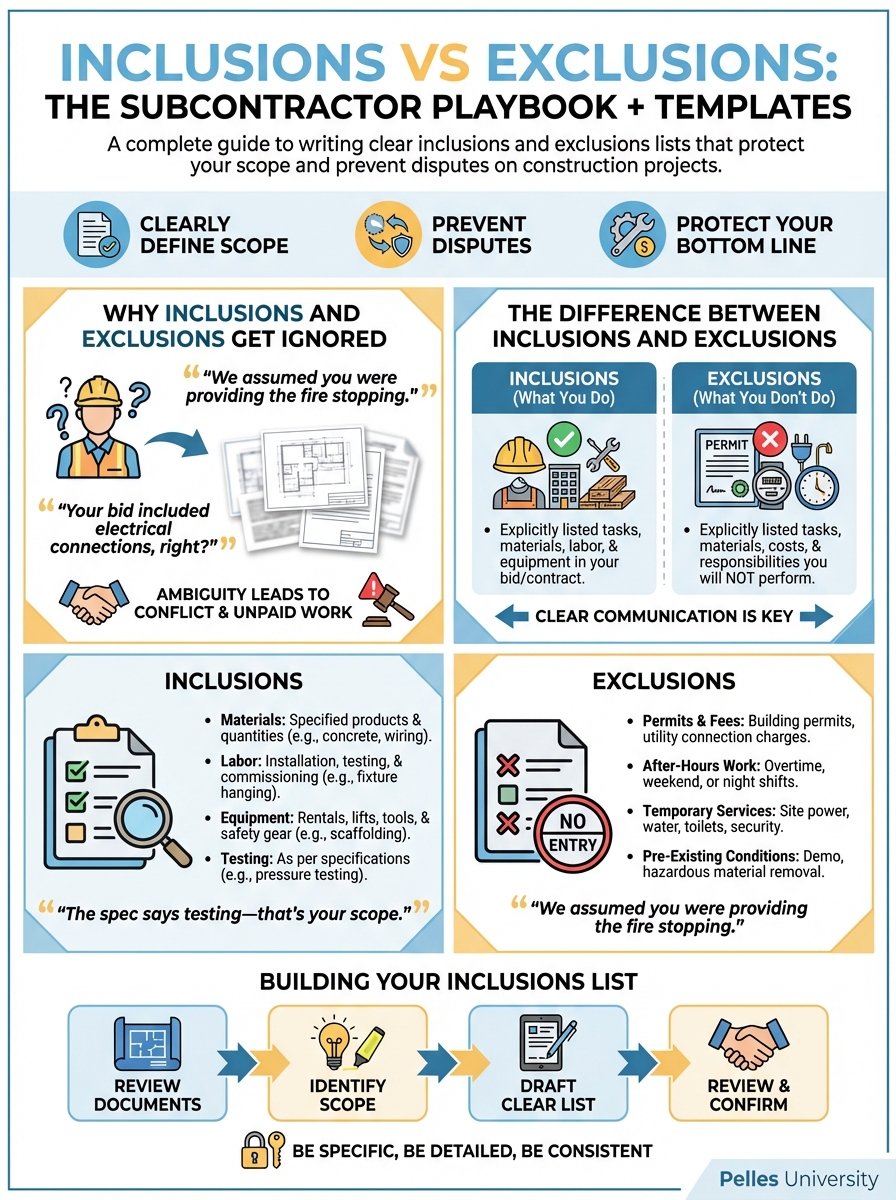
The fastest way to lose money on a project: assume your scope boundaries are understood.
Your inclusions and exclusions list is your first line of defense against scope creep, GC buy-out games, and "that's in your contract" arguments. A good list doesn't just protect you—it prevents disputes before they start.
Here's how to build one that works.
Why Inclusions and Exclusions Get Ignored
Most estimators treat inclusions/exclusions as an afterthought—copy-paste from the last bid, make a few tweaks, done.
Then reality hits:
- "We assumed you were providing the fire stopping."
- "Your bid included electrical connections, right?"
- "The spec says testing—that's your scope."
Every one of these conversations costs you money or relationship capital. Usually both.
The Difference Between Inclusions and Exclusions
Inclusions
What you ARE providing. Be specific enough that there's no ambiguity about what your price covers.
Good inclusion: "Installation of all ductwork shown on Sheets M-201 through M-210, including rectangular duct, round duct, flex connections, and duct accessories."
Exclusions
What you are NOT providing. These fall into categories:
- Scope in the spec but not in your trade – Items that belong to others
- Scope that's unclear – Items you're specifically declining until clarified
- Scope you chose not to price – Optional or alternates you're not including
Good exclusion: "Electrical connections to mechanical equipment. All equipment provided with junction box; final connection by Electrical Contractor."
Building Your Inclusions List
Step 1: Start With Systems
List every system you're responsible for by name.
Example (HVAC):
- Chilled water piping system
- Hot water heating system
- VAV air distribution system
- Kitchen exhaust system
- Building automation and controls
Step 2: Add Equipment
Under each system, list major equipment.
Example (Chilled Water):
- Chilled water pumps (2)
- Air handling units (4)
- VAV terminal units (45)
- Chilled water piping and accessories
Step 3: Define Installation Scope
What does "installation" include for you?
Example:
- Receiving and unloading equipment
- Setting equipment on provided housekeeping pads
- All piping connections
- Duct connections
- Startup and testing
- Commissioning support (X hours)
- Warranty per spec (1 year)
Step 4: List Related Scope
What related scope are you including that might otherwise be ambiguous?
Example:
- Pipe insulation per spec
- Equipment labels and identification
- Seismic bracing per structural drawings
- TAB by certified agency (name if selected)
- Submittal preparation (X submittals)
Building Your Exclusions List
Category 1: By Other Trades
These items are in the project but not your scope:
Standard exclusions (adjust per project):
- Concrete housekeeping pads
- Roof curbs and structural supports
- Electrical power connections
- Fire stopping of penetrations
- Painting of piping (except identification)
- Drywall framing and patching
- Ceiling grid and tile
- General purpose exhaust fans in non-mechanical rooms
Category 2: Conditional Exclusions
Scope that depends on project-specific conditions:
- "Temporary heat—by GC unless specifically negotiated"
- "Winter protection of work—unless included in project logistics"
- "Work above 12' from floor—unless lift is provided by GC"
Category 3: Declined Scope
Items in the spec you're consciously not pricing:
- "Extended warranty beyond one year"
- "O&M training beyond 4 hours"
- "Attic stock beyond code minimum"
Important: If you're declining spec-required scope, you need to be explicit. Otherwise you'll be held to the spec.
The Master Template
Use this format:
INCLUSIONS:

Systems:
• [System 1] - complete as shown on drawings [list sheets]
• [System 2] - complete as shown on drawings [list sheets]

Equipment:
• [Equipment type] - [quantity] per schedule on [drawing reference]
• [Equipment type] - [quantity] per schedule on [drawing reference]

Installation includes:
• Receiving, unloading, and setting equipment
• All [trade] connections
• Startup and testing per spec
• [TAB / Commissioning support] - [X hours / by third party / etc.]
• Submittal preparation
• As-built documentation
• O&M manuals per spec
• Warranty per spec

EXCLUSIONS:

By Other Trades:
• Concrete pads and structural supports
• Electrical power wiring and connections
• Fire stopping
• Painting (except equipment and pipe identification)
• Ceiling work

Conditional:
• Premium time (available at 1.5X labor)
• Temporary heat (by GC or negotiated separately)
• Phased occupancy impacts (bid assumes continuous access)

Not Included:
• Scope identified in Addendum 2 for future phase
• Attic stock beyond code minimum
• Extended warranty beyond 1 year (available as add option)
Using AI to Build Your List
After completing your scope sheet, use this prompt:
Based on this MEP scope, generate a comprehensive inclusions
and exclusions list.

For inclusions:
- List all systems and major equipment
- Define what installation includes
- Note any scope that might be ambiguous

For exclusions:
- List scope typically by other trades
- Identify conditional items based on project type
- Flag any spec requirements we should explicitly decline

Format as a professional bid attachment.
Review and customize—AI doesn't know your specific pricing decisions.
Common Mistakes
Mistake 1: Being Too Vague
"Ductwork installation included" doesn't define what that means. Does it include flex duct? Kitchen hood connections? Fire dampers?
Mistake 2: Forgetting the Obvious
If you assume everyone knows electrical is by the electrician, you're wrong. Someone will argue.
Mistake 3: Not Updating Per Project
Using the same exclusions list for a hospital and a warehouse is lazy. Project types have different scope boundaries.
Mistake 4: Contradicting the Spec
If the spec says fire stopping is by the mechanical contractor, you can exclude it—but you need to acknowledge that you're deviating from the spec.
What's Next
A solid inclusions/exclusions list sets you up for clean buy-out conversations. The next step is turning this into a live document that your PMs use during construction to defend scope—not just a bid attachment that gets filed and forgotten.
TL;DR
- Your inclusions/exclusions list is your first line of defense against scope creep
- Inclusions should be specific: systems, equipment, and what "installation" means
- Exclusions have three categories: by other trades, conditional, and declined scope
- Build a master template but customize it for each project type
- If you're declining spec-required scope, say so explicitly—silence means compliance