You've decided to pursue the job. Now you need to make sure you actually deliver a complete bid—on time, with every form filled out, every bond in place, and every required document attached.
The invitation to bid is usually 5-15 pages of dense requirements. Miss one item and your bid goes in the trash. Here's how to turn that ITB into a working checklist your team can execute.
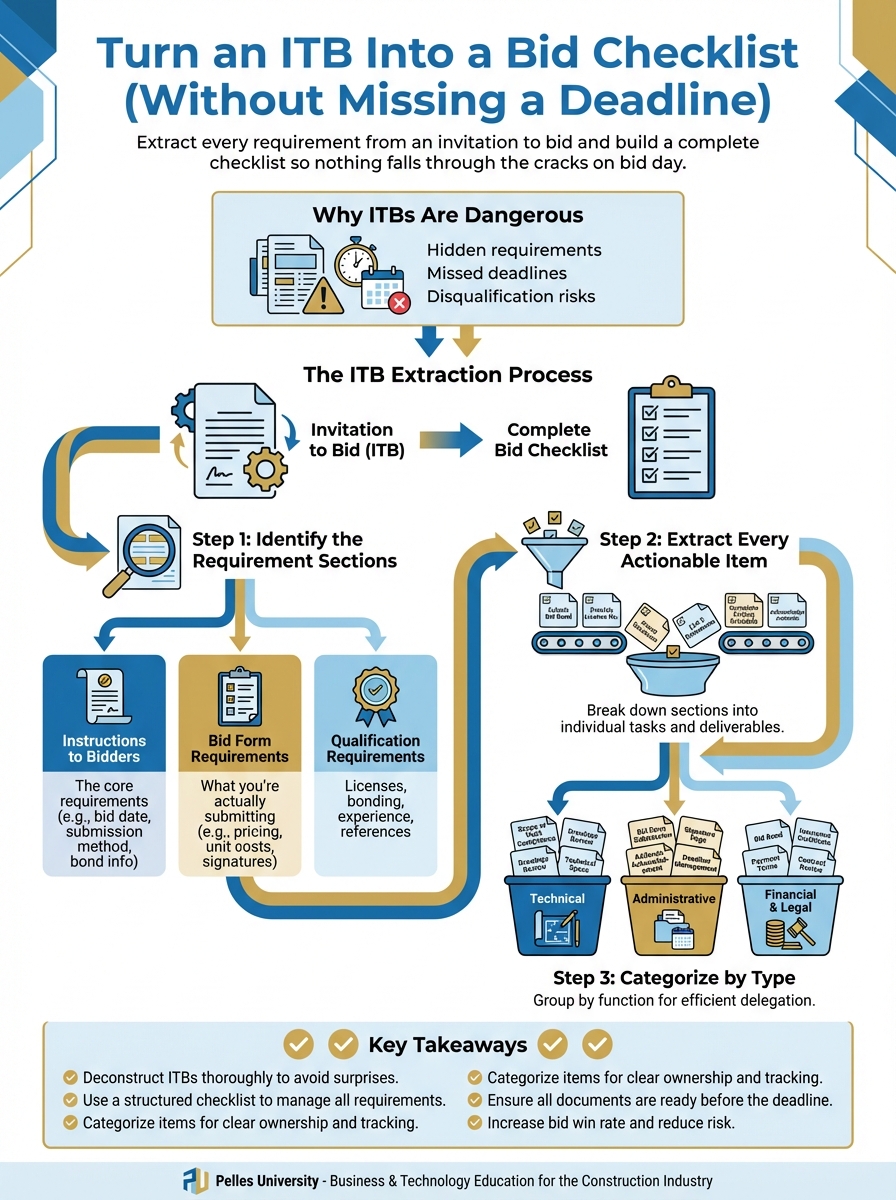
Why ITBs Are Dangerous
The problem with ITBs isn't that the requirements are hidden. It's that they're scattered across multiple sections, mixed with boilerplate, and written by someone who assumes you'll read every word.
You won't. Your estimator is juggling six bids. They'll skim.
That's why you need a system that extracts requirements and puts them in one place, with owners and due dates.
The ITB Extraction Process
Step 1: Identify the Requirement Sections
Most ITBs follow a similar structure. Look for:
- Instructions to Bidders – The core requirements
- Bid Form Requirements – What you're actually submitting
- Qualification Requirements – Licenses, bonding, experience
- Schedule of Values format – If they're prescriptive about it
- Submission Instructions – Where, when, how many copies
Step 2: Extract Every Actionable Item
Go through each section and pull out anything that requires action. Ask:
- Do we need to provide this?
- Do we need to sign this?
- Do we need to obtain this from a third party?
- Is there a specific format required?
Example: A plumbing sub missed a requirement buried on page 8 of an ITB: "Bidders shall include a letter from their surety confirming bonding capacity for the full contract amount." Their bid was rejected—not for price, but for a missing letter.
Step 3: Categorize by Type
Group your extracted items:
Documents to prepare:
- Bid form
- Bid bond
- List of subcontractors (if required)
- Safety program summary
- References
Information to gather:
- License numbers
- Insurance certificate specifics
- Key personnel resumes
Third-party items:
- Surety letter
- Updated insurance certificate
- Manufacturer letters (if specified)
Submission logistics:
- Number of copies
- Electronic vs. physical
- Envelope labeling requirements
- Delivery address and deadline
Step 4: Assign Owners and Deadlines
Every item needs:
- Who is responsible
- When it must be complete (not the bid deadline—the internal deadline)
Build in buffer. If the bid is due Tuesday at 2pm, your internal deadline for assembly is Monday at noon.
Using AI to Speed Up Extraction
Feed the ITB into an AI tool with this prompt:
Review this Invitation to Bid and extract all requirements
the bidder must fulfill. Organize by:
1. Documents to submit
2. Forms to complete
3. Third-party items needed
4. Formatting requirements
5. Submission instructions

For each item, note the page number where it appears.
You'll get a structured list in seconds. Then a human reviews it to catch anything the AI missed or misinterpreted.
The Bid Checklist Template
Here's a simple format that works:
| Item | Source (Page) | Owner | Internal Due | Status |
|---|---|---|---|---|
| Bid bond (5% of bid) | Page 4 | Office Manager | Mon 10am | ⬜ |
| Completed bid form | Page 6 | Estimator | Mon 2pm | ⬜ |
| List of major subs | Page 5 | Estimator | Mon 2pm | ⬜ |
| 3 project references | Page 7 | PM | Fri 5pm | ⬜ |
| Insurance certificate | Page 8 | Office Manager | Mon 10am | ⬜ |
| USB drive + 2 hard copies | Page 3 | Admin | Tue 10am | ⬜ |
Print it. Pin it to the wall. Check items off as they're complete.
Common ITB Traps
The "Or Equal" Trap
ITB says "or equal" products are allowed, but requires substitution requests 10 days before bid. If you're planning alternates, that deadline matters.
The Pre-Bid Meeting Trap
"Attendance at pre-bid meeting is mandatory for bid consideration." Miss it, and you're out.
The Addendum Acknowledgment Trap
You must acknowledge all addenda on the bid form. If Addendum 3 came out and you only acknowledged 1 and 2, you're non-responsive.
The Signature Trap
Bid form requires signature of an officer of the company. Your estimator signs it. Rejected.
Building This Into Your Process
Don't make ITB extraction a one-off task. Build it into your standard workflow:
- Day 1 of bid: ITB gets extracted, checklist created
- Day 2: Checklist reviewed by senior estimator
- Ongoing: Items checked off as completed
- Day before bid: Final checklist review—nothing unchecked
The five minutes you spend on Day 1 saves the panic on bid day.
What's Next
A checklist only works if you use it. The next step is building a template library—standard checklists for different GCs and project types that you can customize rather than create from scratch.
TL;DR
- ITB requirements are scattered and easy to miss—extraction is essential
- Categorize items: documents, forms, third-party items, submission logistics
- Assign owners and internal deadlines with buffer before bid day
- Use AI to speed up extraction, then human-review the output
- Common traps: pre-bid meetings, addendum acknowledgment, signature authority