Your foreman asks a worker to pull wire through conduit overhead. The worker grabs a ladder, climbs up, and starts working.
No JHA. No discussion of hazards. No plan for what happens if the ladder shifts.
This is how incidents happen.
What Is a Job Hazard Analysis?
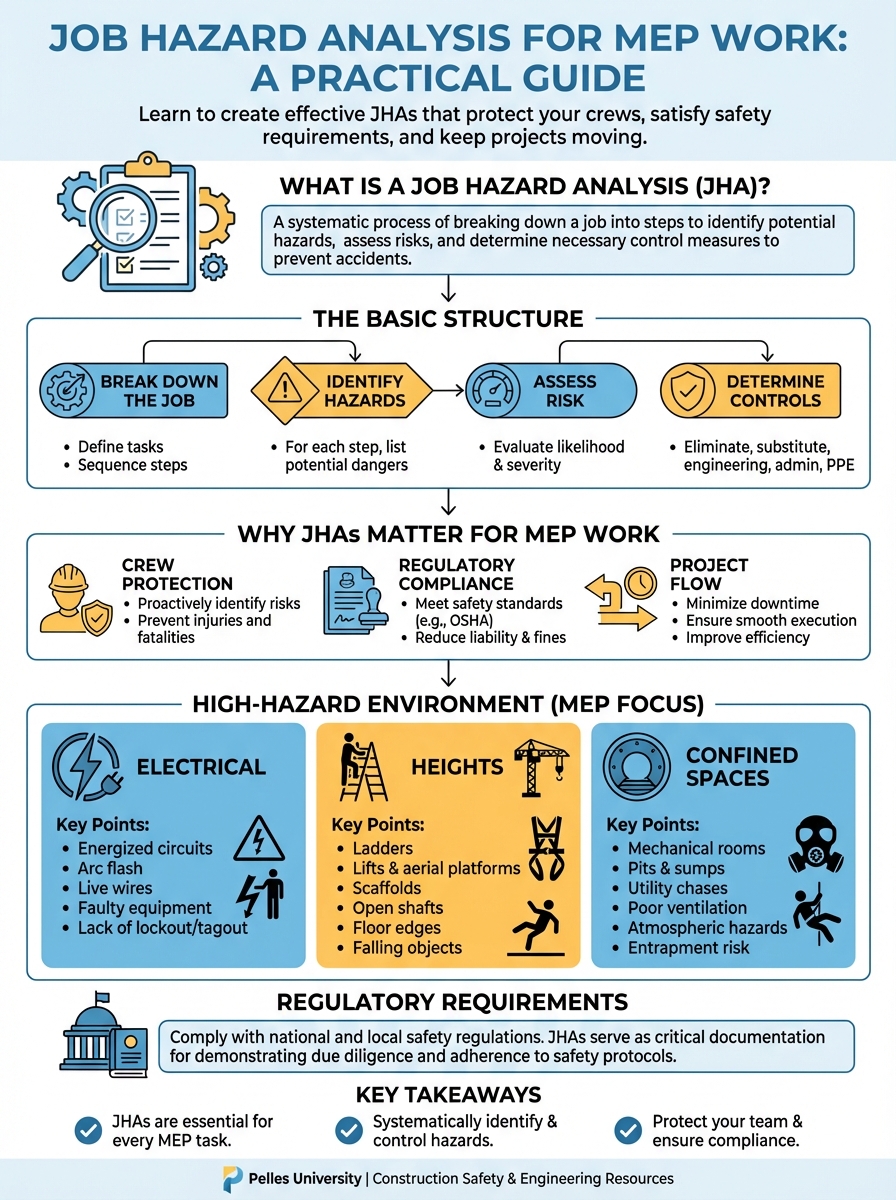
A Job Hazard Analysis (JHA)—sometimes called a Job Safety Analysis (JSA)—is a technique for identifying hazards associated with a task and determining the best way to control them.
It's not paperwork for paperwork's sake. It's a thinking process that prevents injuries.
The Basic Structure
Every JHA answers three questions:
- What are the steps of this task?
- What could go wrong at each step?
- How do we prevent it?
Simple concept. Powerful when done right.
Why JHAs Matter for MEP Work
High-Hazard Environment
MEP work combines multiple hazards:
- Electrical: Energized circuits, arc flash
- Heights: Ladders, lifts, scaffolds, open shafts
- Confined spaces: Mechanical rooms, pits, chases
- Material handling: Heavy equipment, awkward loads
- Environmental: Heat, cold, poor lighting
Each task may involve several of these simultaneously.
Regulatory Requirements
OSHA doesn't specifically require JHAs, but:
- General Duty Clause requires hazard identification
- Many GCs require JHAs for all activities
- Owner safety programs often mandate them
- They demonstrate due diligence
Business Impact
Beyond compliance:
- Fewer injuries = lower EMR = lower insurance
- Fewer incidents = less project disruption
- Better planning = more efficient work
- Documented safety = competitive advantage
Creating Effective JHAs
Step 1: Select the Task
Choose tasks based on:
High priority:
- Tasks with injury history
- New or non-routine work
- High-consequence activities
- Tasks with recent changes
Examples for MEP:
- Installing rooftop equipment
- Working in electrical rooms
- Pulling wire overhead
- Testing fire alarm systems
- Pressure testing piping
Step 2: Break Down the Task
List the basic steps in sequence:
Example: Installing overhead ductwork
| Step | Description |
|---|---|
| 1 | Set up access equipment (lift/scaffold) |
| 2 | Transport duct sections to work area |
| 3 | Install hangers and supports |
| 4 | Lift duct sections into position |
| 5 | Connect sections and seal joints |
| 6 | Secure final connections |
| 7 | Clean up and demobilize |
Keep steps specific enough to identify hazards but not so detailed that the JHA becomes unwieldy.
Step 3: Identify Hazards
For each step, ask:
- What could go wrong?
- What are the consequences?
- Has this caused injury before?
- What environmental factors matter?
Using the ductwork example:
| Step | Hazard |
|---|---|
| Set up lift | Fall from platform, tip-over on uneven surface |
| Transport duct | Strain from lifting, struck by falling material |
| Install hangers | Overhead work strain, dropped tools |
| Lift duct | Crush injury, pinch points, strain |
| Connect sections | Sharp edges, awkward positions |
Step 4: Determine Controls
Apply the hierarchy of controls:
1. Elimination: Remove the hazard entirely
- Prefabricate at ground level instead of overhead
2. Substitution: Replace with something less hazardous
- Use lighter materials when possible
- Substitute mechanical lifting for manual
3. Engineering: Physical changes to the environment
- Guardrails on platforms
- Tool tethers for overhead work
- Proper lifting equipment
4. Administrative: Procedures and training
- Lift plans for heavy items
- Spotters for blind lifts
- Training on proper techniques
5. PPE: Personal protective equipment
- Hard hats
- Safety glasses
- Cut-resistant gloves
Always try to control hazards higher in the hierarchy first. PPE is the last resort.
The JHA Document
Template Structure
A practical JHA includes:
Header information:
- Task description
- Location
- Date
- Prepared by
- Reviewed by
Analysis table:
| Step | Hazards | Controls | Responsible |
|---|---|---|---|
| 1. Set up lift | Fall from platform | Inspect lift, use harness above 6' | Crew lead |
| Tip-over | Check surface level, deploy outriggers | Crew lead | |
| 2. Transport duct | Strain injury | Use mechanical aids for >50 lbs | All crew |
| Struck by | Clear path, team lift for long pieces | All crew |
Sign-off section:
- Crew acknowledgment signatures
- Date of review
- Supervisor verification
What Makes a Good JHA
Specific hazards: "Fall from height" not just "safety concern"
Actionable controls: "Install guardrails" not "be careful"
Clear responsibility: Who ensures each control is in place
Realistic steps: Matches how work is actually performed
Conducting JHA Reviews
Before Work Begins
The JHA isn't complete until the crew reviews it:
Pre-task briefing:
- Gather crew at work location
- Walk through each step
- Discuss each hazard and control
- Ask for additional hazards crew has identified
- Confirm everyone understands their role
- Document participation
When Conditions Change
Review again if:
- Work location changes
- Weather conditions change
- Crew composition changes
- New hazards are identified
- Scope of work changes
After Incidents or Near Misses
Every incident or near miss should trigger:
- JHA review
- Identification of what was missed
- Update to controls
- Re-briefing of crew
Common JHA Mistakes
Mistake 1: Generic JHAs
Wrong: Using the same JHA for every task Right: Tailoring JHAs to specific conditions
A JHA for pulling wire in a finished office is different from pulling wire in an active construction zone.
Mistake 2: Paperwork Exercise
Wrong: Filling out forms without crew discussion Right: Using the JHA as a planning and communication tool
The value is in the thinking and discussion, not the document.
Mistake 3: Ignoring Crew Input
Wrong: Supervisor creates JHA alone Right: Involving workers who do the task
Workers know the hazards. They've experienced near misses. Their input makes JHAs realistic.
Mistake 4: Set and Forget
Wrong: Creating JHA once and never updating Right: Living documents that evolve with the work
Conditions change. New hazards emerge. JHAs must keep pace.
Mistake 5: All PPE Solutions
Wrong: "Wear safety glasses" as the only control Right: Using the full hierarchy of controls
PPE should be supplementary, not primary.
Trade-Specific Hazards
Electrical
| Task | Key Hazards | Critical Controls |
|---|---|---|
| Panel work | Arc flash, shock | LOTO, arc-rated PPE, voltage verification |
| Wire pulling | Strain, electrical contact | Mechanical aids, circuit verification |
| Testing | Shock, burns | Proper test equipment, qualified personnel |
Mechanical
| Task | Key Hazards | Critical Controls |
|---|---|---|
| Equipment rigging | Crush, fall | Lift plan, certified rigging |
| Overhead work | Falls, dropped objects | Fall protection, tool tethers |
| Brazing/welding | Burns, fire, fumes | Hot work permit, fire watch, ventilation |
Plumbing
| Task | Key Hazards | Critical Controls |
|---|---|---|
| Excavation work | Cave-in, utilities | Competent person, locate tickets |
| Pressure testing | Rupture, projectiles | Pressure limits, clear zone |
| Sanitary connections | Biological hazards | PPE, hygiene protocols |
Using AI for JHA Development
Identifying Hazards
I'm creating a JHA for installing VRF condensing units on a rooftop.
List potential hazards for each of these steps:

1. Rigging equipment to roof
2. Positioning units
3. Making refrigerant connections
4. Making electrical connections
5. Startup and testing

Consider: fall hazards, rigging hazards, electrical hazards,
refrigerant hazards, and environmental factors.
Suggesting Controls
For this hazard, suggest controls using the hierarchy:

Hazard: Installing overhead pipe supports requires working
from a ladder with hands occupied.

Provide at least one option for:
- Elimination
- Substitution
- Engineering
- Administrative
- PPE
Reviewing Completeness
Review this JHA for completeness:

[Paste your JHA]

Check for:
- Missing steps
- Unaddressed hazards
- Insufficient controls
- Controls that are only PPE
- Unclear responsibilities
Building a JHA Library
Organizing by Task Type
Create categories:
- Electrical tasks: Panel installation, wire pulling, terminations
- Mechanical tasks: Equipment setting, ductwork, piping
- Plumbing tasks: Underground, overhead, testing
- General tasks: Material handling, housekeeping, ladder use
Template JHAs
Develop templates for routine work:
- Start with complete hazard identification
- Include standard controls
- Leave space for site-specific additions
- Require review and customization before use
Templates save time while ensuring thorough coverage.
Continuous Improvement
Track JHA effectiveness:
- Which JHAs are used most often?
- Which tasks have incidents despite JHAs?
- What hazards are being missed?
- What controls aren't being followed?
Use this data to improve your JHA library.
What's Next
JHAs address task-specific hazards. The next level is connecting these to your overall safety program—toolbox talks, training, and incident investigation—so safety becomes part of how your crews think about every task.
TL;DR
- JHAs identify hazards and controls before work begins—not paperwork, a thinking process
- Break tasks into steps, identify what could go wrong, apply controls from the hierarchy
- Elimination and engineering controls are more effective than PPE alone
- Review JHAs with crews before work and when conditions change
- Use templates for efficiency but customize for specific conditions
- Track incidents and near misses to continuously improve your JHAs