The project is 30 days late. The owner assesses $150,000 in liquidated damages. And now the GC wants to know who's paying.
Liquidated damages (LDs) are a fact of life on many projects. The question isn't whether they exist—it's whether you understand your exposure and have protected yourself appropriately.
What Are Liquidated Damages?
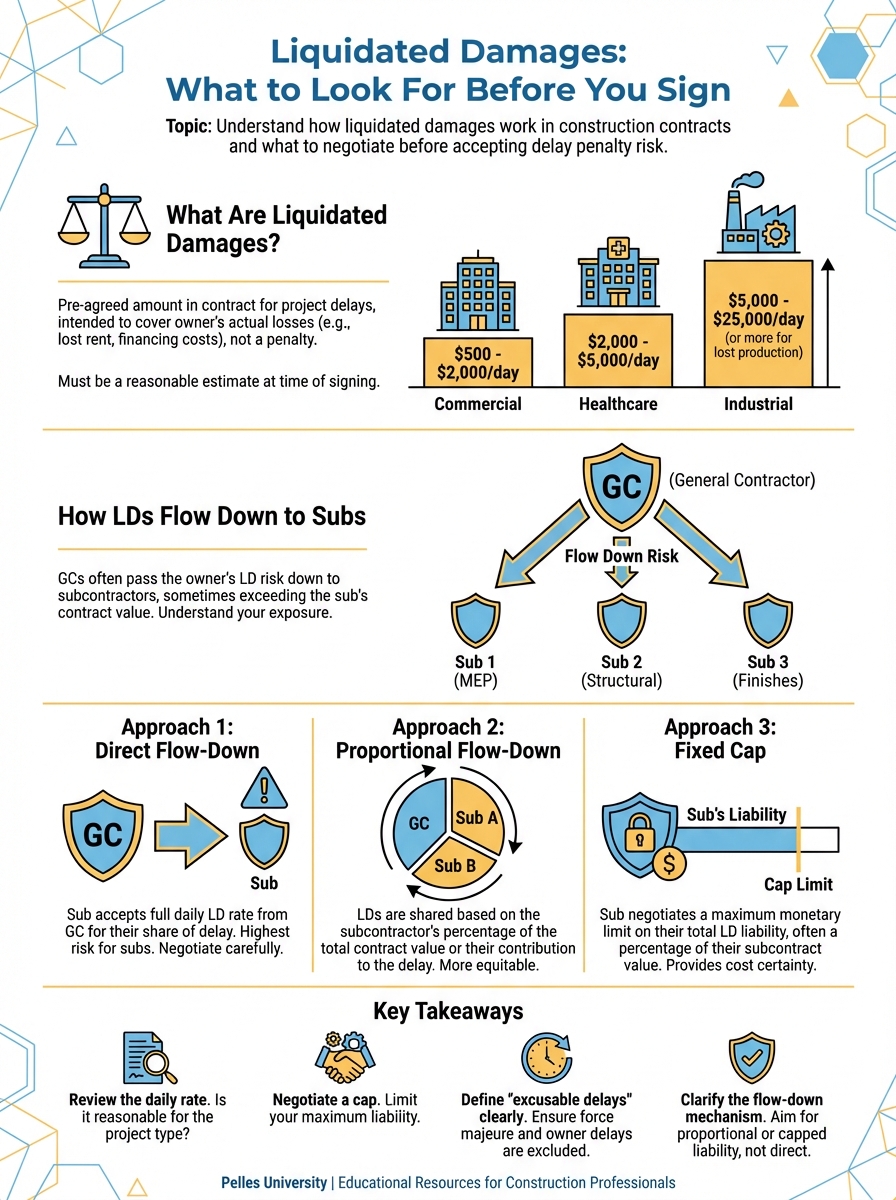
Liquidated damages are pre-agreed amounts the owner can deduct for project delays, without having to prove actual damages.
Typical LD amounts:
- Commercial: $500-$2,000/day
- Healthcare: $2,000-$5,000/day
- Industrial: $5,000-$25,000/day (or more for lost production)
Why owners use them:
- Easier than proving actual delay damages
- Creates contractor motivation to finish on time
- Provides budget certainty for delay scenarios
Why they matter to you:
- GCs often flow LDs down to subs
- Your share may not be proportional to your contract value
- You may be liable for delays you didn't cause
How LDs Flow Down to Subs
There are three common approaches:
Approach 1: Direct Flow-Down
The prime contract LD rate applies directly to your subcontract.
"Subcontractor shall be liable to Contractor for liquidated damages at the rate specified in the Prime Contract for each day of delay attributable to Subcontractor."
Risk: If the LD is $5,000/day and your contract is $200,000, ten days of delay costs you 25% of your contract value.
Approach 2: Proportional Flow-Down
Your LD exposure is proportional to your contract percentage.
"Subcontractor's maximum liability for delay shall be proportional to the ratio of Subcontract value to Contract value."
Risk: More reasonable, but still requires you to know the calculation.
Approach 3: Fixed Cap
Your LD exposure is capped regardless of prime contract terms.
"Subcontractor's liability for delay shall not exceed $500 per day, up to a maximum of $25,000."
Risk: Limited exposure, but you need to negotiate this language.
What to Look For in LD Clauses
1. The Daily Rate
Is it stated in your subcontract? If not, where is it defined?
2. The Cap
Is there a maximum? Many subcontracts don't cap LD exposure, meaning you could owe more than your contract value.
3. The Trigger
What constitutes "delay"? Your delay specifically, or any delay you contributed to?
4. Concurrent Delay Treatment
What happens when both you and another party cause delay? Some contracts still hold you liable even if you weren't the sole cause.
5. Delay Notice Requirements
What notice must you give to preserve your right to claim delay impacts?
6. Extension of Time Process
How do you request schedule relief, and what documentation is required?
Negotiating LD Terms
Negotiation 1: Cap Your Exposure
Push for language like:
"Subcontractor's maximum liability for liquidated damages shall not exceed 5% of the Subcontract value, regardless of the duration of delay."
Or an absolute cap:
"Subcontractor's total liability for delay, including liquidated damages, shall not exceed $50,000."
Negotiation 2: Limit to Your Delays Only
Push for language like:
"Subcontractor shall be liable for liquidated damages only for delays solely caused by Subcontractor, and only for the period of delay directly attributable to Subcontractor's actions."
Negotiation 3: Exclude Concurrent Delays
"Subcontractor shall not be liable for delays caused by others, concurrent delays, or delays due to causes beyond Subcontractor's control."
Negotiation 4: Add Notice Requirements
"Contractor shall provide written notice to Subcontractor of any claimed delay within 10 days of discovery. Failure to provide timely notice waives Contractor's claim."
The LD Review Checklist
Before signing:
Rate and calculation:
- Daily rate is stated or referenced
- Calculation method is clear
- Cap on total exposure exists
Trigger and attribution:
- Delay must be solely your fault
- Concurrent delay excluded
- Mitigation credit for acceleration
Process:
- Extension of time process defined
- Notice requirements reasonable (14+ days)
- Documentation requirements clear
Flow-down alignment:
- Your LD terms match what GC has with owner
- You have the same defenses available to GC
Common LD Situations
Scenario 1: The Late Equipment Your equipment arrives 10 days late due to supply chain issues. GC assesses LDs.
Defense: Review force majeure and excusable delay provisions. Supply chain disruption may qualify.
Scenario 2: The Cascading Delay Structural steel is late. This delays your rough-in. GC still assesses LDs for your milestone.
Defense: Your delay was caused by predecessor work. Document the dependency and push back.
Scenario 3: The Acceleration Demand Project is behind. GC demands acceleration. You accelerate and still face LD claims for original milestone.
Defense: Acceleration agreement should address LD waiver. Get it in writing before accelerating.
Using AI for LD Clause Review
Review this contract for liquidated damages exposure:

[Paste contract text]

Identify:
1. Daily LD rate and how it's calculated
2. Maximum exposure (cap, if any)
3. Triggering conditions for LD assessment
4. Treatment of concurrent delays
5. Notice and extension of time procedures
6. Any flow-down from prime contract

Assess the risk level and suggest negotiation points.
What's Next
Understanding LD exposure is step one. The next step is building LD risk into your bid—either by pricing the risk, limiting it through negotiation, or declining projects with unreasonable LD terms.
TL;DR
- Liquidated damages can exceed your profit margin—know your exposure before signing
- Look for daily rate, cap, trigger conditions, and concurrent delay treatment
- Negotiate caps (percentage of contract or absolute dollar amount)
- Push for liability only for delays you solely cause
- Document any delays caused by others immediately—your defense depends on your records