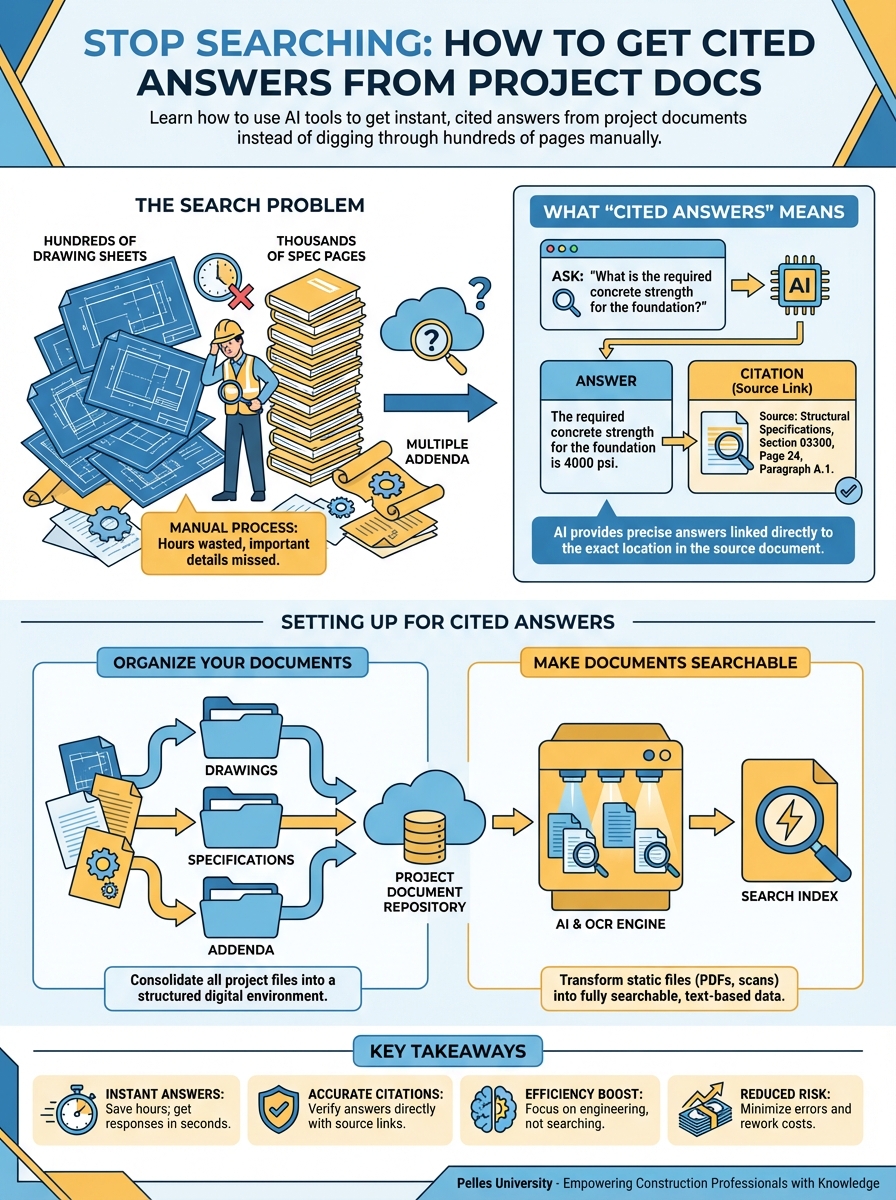
"What's the required clearance around the electrical panel?"
You know it's in the documents somewhere. But is it in the drawings? The specs? The code reference? Division 26? An addendum?
Fifteen minutes later, you're still searching.
Here's how to stop searching and start getting cited answers.
The Search Problem
Modern construction projects generate massive document sets:
- Hundreds of drawing sheets
- Thousands of spec pages
- Multiple addenda
- RFI logs
- Submittals
- Meeting minutes
When someone asks a question, you know the answer exists. You just don't know where.
Traditional approaches:
- Manual document review (slow)
- Text search in PDF (misses context)
- Asking whoever remembers (unreliable)
- Guessing (dangerous)
What "Cited Answers" Means
A cited answer includes two things:
1. The actual answer: Clear, direct response to your question
2. The source: Exact document, page, section, and paragraph where that answer comes from
This matters because:
- You can verify the answer
- You have documentation for disputes
- You can share the source with others
- You build trust in the information
Setting Up for Cited Answers
Organize Your Documents
Before you can get cited answers, documents need to be searchable:
Consolidated project folder:
Project X/
├── Drawings/
│   ├── Architectural/
│   ├── Structural/
│   ├── Mechanical/
│   ├── Electrical/
│   └── Plumbing/
├── Specifications/
│   ├── Division 22/
│   ├── Division 23/
│   └── Division 26/
├── Addenda/
├── RFIs/
└── Submittals/
Naming conventions:
- Include revision/date in filenames
- Use consistent prefixes
- Keep original document names when possible
Make Documents Searchable
PDFs from scans often aren't text-searchable. Solutions:
- Use OCR on scanned documents
- Request vector PDFs from design team
- Convert CAD exports to searchable format
If documents aren't searchable, no tool can help you.
Using AI for Document Questions
Modern AI tools can search across documents and return cited answers. Here's how to use them effectively:
Ask Specific Questions
Vague question: "What about electrical panels?"
Specific question: "What is the required working clearance in front of electrical panels per the project specifications?"
Specific questions get specific answers.
Include Context
Basic query: "What's the duct insulation requirement?"
Contextual query: "What is the insulation type and R-value required for supply air ductwork in the mechanical room per the project specifications?"
Context helps the AI find the right section.
Request Citations
Always ask for the source:
What is the minimum slope required for sanitary drainage piping?

Please cite the specific specification section and paragraph number.
This forces the response to include verification.
Common Field Questions and How to Ask Them
Specification Requirements
Question: "What's required for this installation?"
Better: "Per the specifications, what are the installation requirements for VAV box terminal units, including access requirements and duct connections?"
Code References
Question: "What's the code requirement?"
Better: "Does the project specification reference a specific code edition for electrical installation, and what clearances does it require for the 400A panel?"
Coordination Requirements
Question: "Do we need to coordinate with anyone?"
Better: "Per the specifications, what coordination requirements exist between Division 23 mechanical work and Division 26 electrical work for the mechanical room equipment?"
Testing and Commissioning
Question: "What testing do we need?"
Better: "What testing requirements are specified for the chilled water piping system, including pressure test values and documentation requirements?"
Building a Question Library
Common questions repeat across projects. Build a library:
Equipment Installation Questions
- What are the access/clearance requirements for [equipment type]?
- What are the anchoring/seismic requirements for [equipment type]?
- What electrical requirements does [equipment type] need?
- What pipe/duct connection sizes are specified for [equipment type]?
Material Questions
- What is the specified material for [system type] piping?
- What insulation type and thickness is required for [system type]?
- What fitting types are acceptable for [material type] piping?
- What hanger types and spacing are required for [system type]?
Testing Questions
- What pressure test is required for [system type]?
- What documentation is required for [test type]?
- Who needs to witness [test type]?
- What's the hold time for [test type]?
Closeout Questions
- What O&M documentation is required for [equipment type]?
- What training is required per the specifications?
- What warranty duration is specified for [equipment/system]?
- What as-built documentation format is required?
When Citations Conflict
Sometimes you'll find multiple sources saying different things:
Drawing note: "Provide 1" insulation on all HVAC piping" Specification: "Provide 1.5" insulation on chilled water piping"
When this happens:
- Note both sources with exact citations
- Identify the conflict clearly
- Submit an RFI referencing both documents
- Get written clarification before proceeding
Documentation of the conflict protects you.
Response Verification
AI tools can make mistakes. Always verify:
Quick Verification
- Open the cited document
- Navigate to the cited location
- Confirm the text matches
Cross-Reference Check
- Does the citation make sense in context?
- Are there related sections that might modify this?
- Have addenda changed this requirement?
Completeness Check
- Is this the only relevant reference?
- Are there other sections that affect this answer?
- Does Division 01 have overriding requirements?
Training Your Team
Getting value from cited answer tools requires training:
What to Train
- How to ask effective questions (specific, contextual)
- How to verify citations (don't trust blindly)
- When to escalate (complex questions, conflicts)
- How to document (save important Q&As for reference)
Common Mistakes to Avoid
- Trusting answers without verification
- Asking vague questions and accepting vague answers
- Not cross-referencing with addenda
- Forgetting to check submittal modifications
Building Institutional Knowledge
Over time, cited answers become institutional knowledge:
Document Frequent Questions
Keep a project FAQ with verified answers:
| Question | Answer | Source |
|---|---|---|
| Panel clearances | 36" front, 30" sides | Spec 26 05 00 3.2.1 |
| Pipe insulation | 1.5" fiberglass | Spec 23 07 13 2.3.A |
| Testing pressure | 150% design | Spec 22 05 00 3.4.2 |
Share Across Teams
When one person finds an answer, make it available to everyone:
- Share in project communication channels
- Add to project documentation
- Include in coordination meetings
Update for Changes
When addenda or RFIs modify requirements:
- Flag affected FAQ entries
- Update with new citations
- Note the change history
What's Next
Getting cited answers is step one. The next step is building workflows that proactively surface important requirements—so you're not waiting for questions to arise before finding critical information.
TL;DR
- Stop searching manually—use AI tools to get cited answers from project documents
- Ask specific questions with context to get useful responses
- Always verify citations by checking the original document
- Build a library of common questions to speed up repeated lookups
- Document conflicts between sources and resolve through RFIs