The foreman reads the same script about ladder safety for the third time this month. Half the crew is on their phones. The other half is staring at their boots.
Everyone signs the sheet. No one remembers anything.
This is what toolbox talks look like when they're treated as paperwork instead of communication.
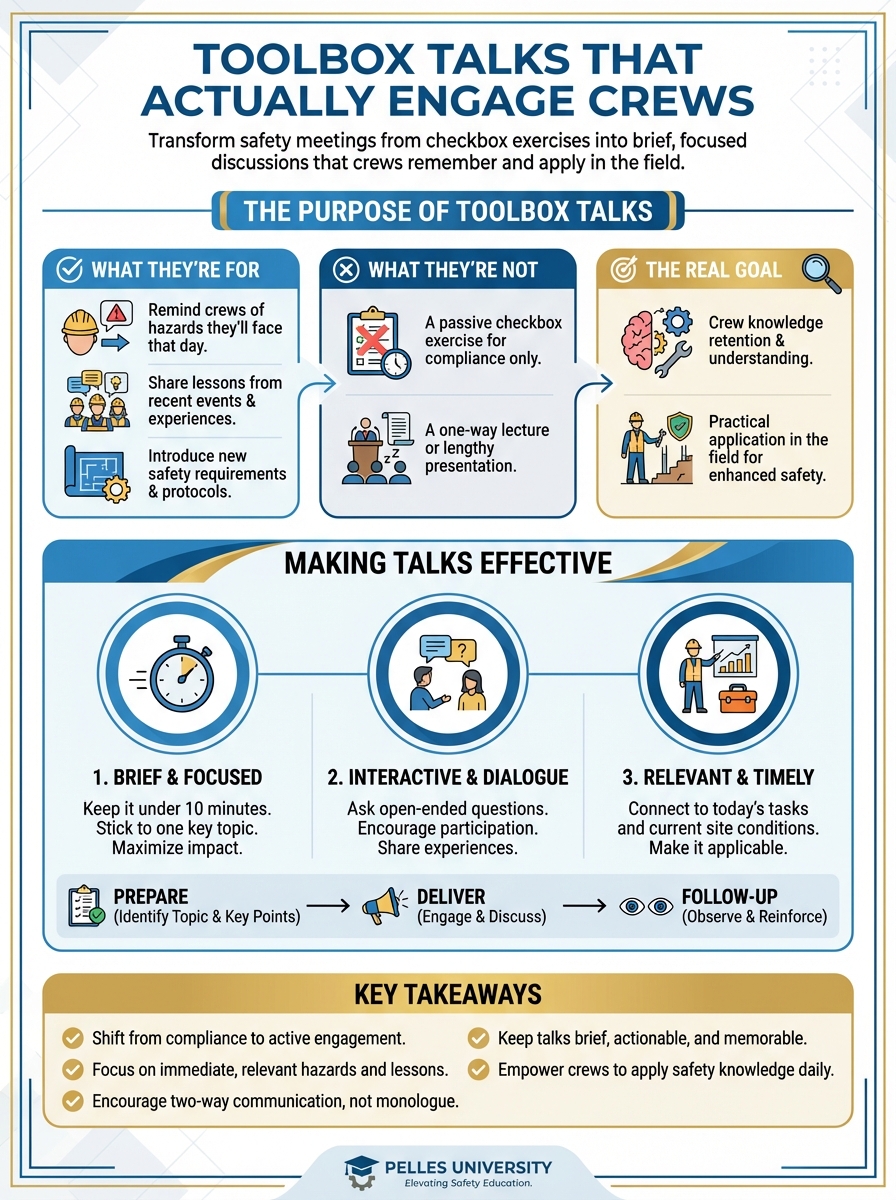
The Purpose of Toolbox Talks
What They're For
Toolbox talks are brief safety discussions that:
- Remind crews of hazards they'll face that day
- Share lessons from recent events
- Introduce new safety requirements
- Create space for crew questions and concerns
What They're Not
Toolbox talks are not:
- Comprehensive training (that's separate)
- Punishment for past incidents
- Reading aloud from OSHA regulations
- Checkbox exercises for documentation
The Real Goal
One key takeaway that crews remember and apply.
That's it. If your crew walks away with one thing they'll do differently, the talk succeeded.
Making Talks Effective
Keep Them Short
Target: 5-10 minutes
Attention drops sharply after 10 minutes. A focused 5-minute talk beats a meandering 30-minute meeting.
Structure:
- Hook (30 seconds): Why this matters today
- Core content (3-5 minutes): The key points
- Discussion (2-3 minutes): Questions and crew input
- Takeaway (30 seconds): The one thing to remember
Make Them Relevant
Wrong approach: Generic ladder safety on a day with no ladder work
Right approach: Ladder safety when crews are actually using ladders
Connect every topic to:
- Today's specific tasks
- This week's conditions
- Recent events on this project
- Hazards crews will actually face
Use Real Examples
Generic: "Falls are dangerous."
Specific: "Yesterday, I saw someone lean too far reaching for conduit. Here's what almost happened..."
Real stories from your jobsite, your company, or your experience stick better than statistics.
Involve the Crew
Don't: Lecture for 10 minutes Do: Ask questions and listen to answers
Good questions:
- "What's the most dangerous part of what we're doing today?"
- "Has anyone seen this go wrong before?"
- "What would you do if you saw someone doing this unsafely?"
Crews who talk are crews who think.
Timing and Frequency
Daily Talks
For high-hazard activities:
- Before starting work each day
- When new hazards are introduced
- After any safety incident
Topics tied to that day's work.
Weekly Talks
Minimum requirement for most sites:
- Rotating through key topics
- Addressing seasonal hazards
- Reviewing company safety focus areas
Plan topics ahead but adjust for current conditions.
Triggered Talks
Immediate response to:
- Near misses (within 24 hours)
- New equipment or tools
- Changed conditions
- Weather events
- Incidents on similar projects
Strike while the learning is fresh.
Topic Selection
Connect to Current Work
Example calendar:
| Week | Scheduled Work | Toolbox Topic |
|---|---|---|
| 1 | Underground rough-in | Trench safety, utility strikes |
| 2 | Overhead rough-in | Fall protection, ladder safety |
| 3 | Equipment setting | Rigging, pinch points |
| 4 | Testing systems | LOTO, pressure testing |
Match topics to exposure.
Seasonal Considerations
Summer:
- Heat illness prevention
- Sun exposure
- Hydration requirements
- Working in hot spaces
Winter:
- Cold stress
- Slips on ice
- Shortened daylight
- Space heater hazards
Spring/Fall:
- Weather changes
- Transitional PPE
- Allergies and outdoor work
Trade-Specific Topics
Electrical:
- Arc flash awareness
- LOTO procedures
- Testing equipment safety
- Working near energized parts
Mechanical:
- Rigging and lifting
- Overhead work hazards
- Hot work safety
- Confined space entry
Plumbing:
- Excavation safety
- Pressure testing
- Biological hazards
- Tool safety for cutting
Delivery Techniques
Location Matters
Good locations:
- At the work area itself
- Where you can point to actual hazards
- Where everyone can see and hear
Bad locations:
- Remote trailer far from work
- Noisy areas requiring shouting
- Areas with distractions
When possible, deliver talks at the work location.
Visual Aids
Effective visuals:
- Actual equipment being discussed
- Photos of correct vs. incorrect
- Damaged PPE examples
- Simple diagrams on a whiteboard
Ineffective visuals:
- Dense text-heavy slides
- Generic stock photos
- Complicated charts
Keep it simple and tangible.
Speaking Tips
Do:
- Make eye contact
- Use names
- Move around the group
- Ask questions
- Pause for responses
Don't:
- Read from a script word-for-word
- Talk to your clipboard
- Rush through to finish
- Dismiss questions
- Lecture or scold
You're leading a conversation, not giving a presentation.
Handling Discussions
Encouraging Participation
Start with easy questions:
- "Anyone used this equipment before?"
- "What's the weather supposed to be today?"
- "Who's worked in spaces like this before?"
Then move to safety questions:
- "What hazards should we watch for?"
- "What's our plan if something goes wrong?"
- "Any concerns about today's work?"
Dealing with Silence
If crews don't respond:
- Ask someone by name (respectfully)
- Share your own experience first
- Ask about past projects
- Give them a moment—silence is okay
Don't answer your own questions immediately.
Addressing Wrong Answers
When someone gives an unsafe answer:
Wrong: "No, that's completely wrong."
Right: "I can see how you'd think that. Here's what I've seen work better..."
Correct without embarrassing. You want people to speak up next time.
When Someone Raises a Concern
Take it seriously:
- Thank them for raising it
- Discuss how to address it
- Follow up visibly
- Report back at next talk
Ignored concerns = silent crews.
After Near Misses
The 24-Hour Talk
When something almost goes wrong:
Do immediately:
- Stop work if needed
- Gather facts while fresh
- Plan a talk for next morning
The talk structure:
- What happened (facts only)
- What could have happened
- Why it happened
- How we prevent it
- Questions and discussion
No Blame, Just Learning
Focus on systems, not individuals:
Wrong: "John almost fell because he was being careless."
Right: "We had a near miss at the roof edge. Let's talk about what contributed and how we prevent it."
Blame shuts down reporting. Learning keeps incidents visible.
Documenting Near Miss Talks
Record:
- Date and time
- Description of near miss
- Discussion points
- Corrective actions decided
- Attendees
This documentation shows your safety program is responsive.
Documentation
What to Record
For every toolbox talk:
- Date and time
- Location
- Topic covered
- Key points discussed
- Questions raised
- Attendee signatures
Why It Matters
Documentation proves:
- Training occurred
- Topics were covered
- Crews were informed
In an incident investigation or OSHA inspection, this matters.
Simple Format
TOOLBOX TALK RECORD

Date: ___________  Time: ___________
Project: ___________
Presented by: ___________

Topic: ___________

Key Points Discussed:
1. ___________
2. ___________
3. ___________

Questions/Concerns Raised: ___________

Attendees:
Name                    Signature
___________            ___________
___________            ___________
Keep it simple. Complex forms don't get completed.
Building a Talk Library
Organizing Topics
Create categories:
General safety:
- PPE usage
- Housekeeping
- Emergency procedures
- Hazard reporting
Task-specific:
- Ladder safety
- Scaffold safety
- Power tool safety
- Material handling
Trade-specific:
- Electrical safety
- LOTO procedures
- Hot work safety
- Pressure testing
Template Development
For each topic, prepare:
- Main talking points (3-5 bullet points)
- Discussion questions (2-3 questions)
- Common misconceptions to address
- Connection to current work (customize)
Templates save time while allowing customization.
Using AI for Toolbox Talks
Generating Topics
Create a 5-minute toolbox talk outline for MEP crews about
working in hot weather.

Include:
- Opening hook
- 3 key points
- 2 discussion questions
- One clear takeaway

Keep it conversational, not technical.
Customizing for Conditions
Adapt this ladder safety toolbox talk for crews working in
a finished hospital wing:

[Paste your standard talk]

Consider:
- Hospital-specific concerns
- Patient and staff traffic
- Floor surfaces
- Space constraints
Post-Incident Talks
Help me prepare a toolbox talk about a near miss:

What happened: Worker's ladder slipped while reaching for
conduit, caught themselves on nearby pipe.

Create a non-blaming talk that:
- Describes what happened
- Identifies contributing factors
- Discusses prevention
- Encourages reporting
What's Next
Effective toolbox talks build awareness. The next level is connecting this to your broader safety documentation system—incident tracking, training records, and compliance documentation that work together to protect crews and your company.
TL;DR
- Keep talks to 5-10 minutes with one clear takeaway
- Connect every topic to that day's actual work
- Use real examples and involve the crew in discussion
- Conduct talks at the work location when possible
- Discuss near misses within 24 hours without blame
- Document attendance, topics, and discussions for every talk