Standard warranty is one year from substantial completion. Simple, right?
Except when the contract says two years. Or five. Or "manufacturer's standard." Or requires warranty service within 4 hours of a call. Or extends the warranty period every time you do warranty work.
Warranty language is where reasonable-sounding terms become expensive obligations. Here's how to spot the problems before you sign.
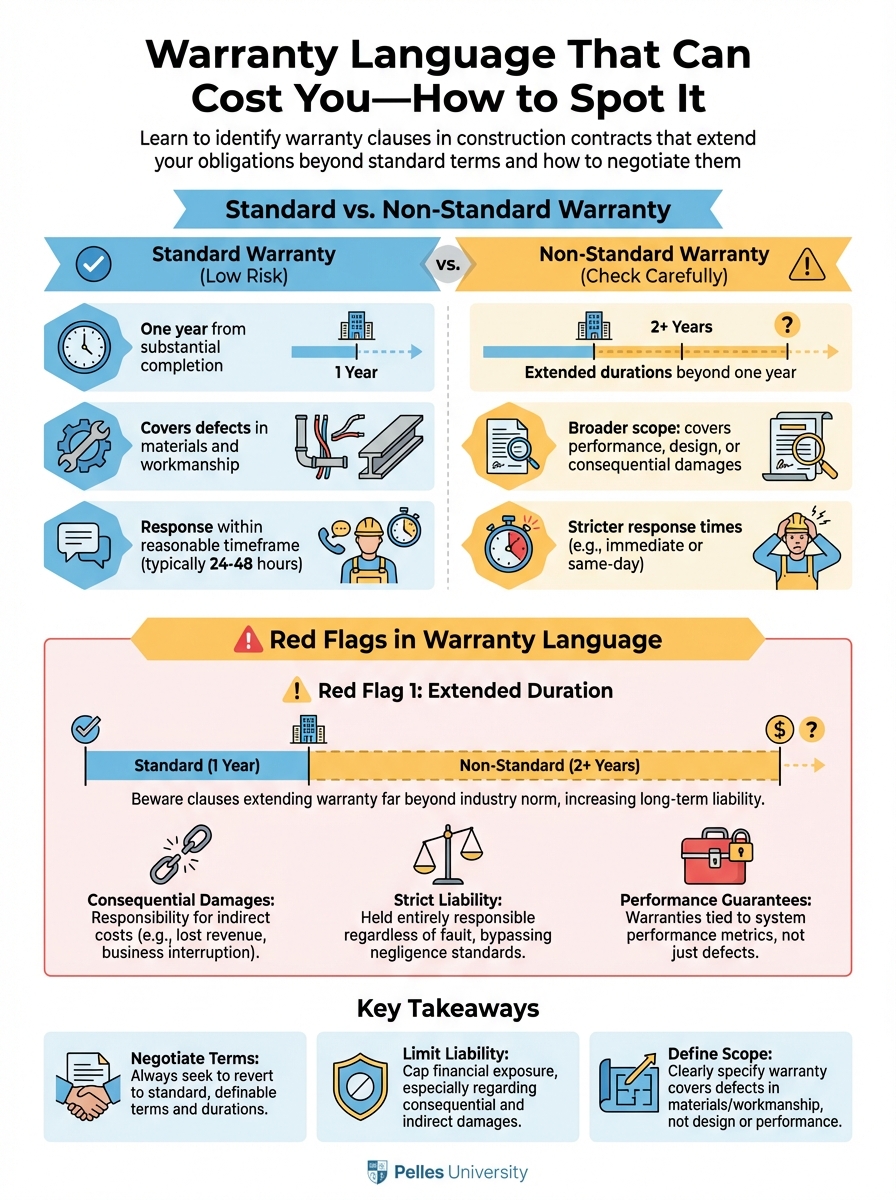
Standard vs. Non-Standard Warranty
Standard Warranty (Low Risk)
- One year from substantial completion
- Covers defects in materials and workmanship
- Response within reasonable timeframe (typically 24-48 hours)
- Replacement parts at your cost; labor at your cost
- No extension for warranty repairs
Non-Standard Warranty (Check Carefully)
- Duration longer than one year
- Starts from beneficial occupancy (earlier than substantial completion)
- Includes performance guarantees
- Specifies response times (4-hour, same-day)
- Extends for repairs ("warranty clock resets")
- Requires warranty bond
Red Flags in Warranty Language
Red Flag 1: Extended Duration
"Subcontractor warrants all work for a period of five (5) years from the date of final completion."
Problem: Five years of warranty service is a service contract, not a warranty. You need to price ongoing labor and potential parts.
Example: An HVAC sub signed a 5-year warranty on a chiller. Year 4, the compressor failed. Cost to replace: $18,000 in parts and labor—far exceeding their original profit on the job.
Red Flag 2: The Rolling Warranty
"The warranty period shall be extended by a period equal to the time any warranted item is not operational due to defects."
Problem: Every repair restarts the clock. Your one-year warranty could become a three-year warranty.
Red Flag 3: Performance Guarantees
"Subcontractor warrants that all systems shall meet the specified performance requirements for the duration of the warranty period."
Problem: Performance is affected by owner operation, maintenance, and conditions you don't control. Are you responsible if they don't change filters?
Red Flag 4: Response Time Requirements
"Subcontractor shall respond to warranty calls within four (4) hours and have qualified technicians on-site within eight (8) hours."
Problem: This is a service contract requiring 24/7 coverage. Do you have that capacity? What's the cost?
Red Flag 5: Delayed Start Date (Project Completion)
"Warranty period shall commence upon Final Completion of the entire Project."
Problem: If you are a foundation sub or an early MEP rough-in sub, your work might be done 2 years before the "entire Project" is finished. If your warranty waits until then to start, you are effectively providing a 3-year warranty instead of a 1-year warranty.
Red Flag 6: Warranty Bonds
"Subcontractor shall provide a warranty bond equal to 15% of the subcontract value for the duration of the warranty period."
Problem: Bonds cost money. Extended warranty bonds cost more. Your surety may not even write them.
Acceptable Warranty Modifications
Some warranty adjustments are reasonable if priced:
- Two-year warranty on equipment – Manufacturer often provides this anyway
- One-year warranty on consumables – Limited scope, manageable risk
- Response within 24-48 business hours – Standard service level
Get these in writing with clear scope definitions.
How to Negotiate Warranty Terms
Approach 1: Match Manufacturer Warranty
"Subcontractor's warranty shall be coextensive with manufacturer's standard warranty, not to exceed two (2) years. Extended warranties available upon request for additional cost."
This limits you to what manufacturers actually cover.
Approach 2: Cap Service Obligations
"Response to warranty calls shall be within 48 business hours. After-hours and emergency service available at Subcontractor's then-current service rates."
This protects you from 24/7 coverage requirements without compensation.
Approach 3: Exclude Performance Guarantees
"Warranty covers defects in materials and workmanship. System performance is dependent on proper operation and maintenance by Owner in accordance with O&M manual."
This distinguishes between workmanship (your responsibility) and performance (shared responsibility).
Approach 4: Define Warranty Start Date
"Warranty period shall commence on the date of Subcontractor's completion of punch list, regardless of Owner occupancy."
This prevents early beneficial occupancy from eroding your warranty period.
The Warranty Review Checklist
Before signing:
Duration:
- Warranty period stated (1 year, 2 year, etc.)
- Start date defined (substantial completion, beneficial occupancy, other)
- No rolling warranty / restart provisions
Scope:
- Limited to defects in materials and workmanship
- Performance guarantees excluded or limited
- Consumables and maintenance items excluded
Service levels:
- Response time reasonable (24-48 hours)
- After-hours service compensated separately
- No 24/7 requirements without pricing
Financial:
- No warranty bond required, or priced if required
- Extended warranty available as add option
- Clear process for warranty claim approval
Using AI to Review Warranty Clauses
Review this contract for warranty obligations:

[Paste contract text]

Identify:
1. Warranty duration and start date
2. Scope of warranty coverage
3. Response time or service level requirements
4. Any rolling warranty or extension provisions
5. Warranty bond requirements
6. Performance guarantees or outcome-based terms

For each finding, assess the risk level and suggest negotiation language.
What's Next
Understanding warranty language protects you at contract signing. The next step is building warranty tracking into your project closeout—so you know when warranties expire and what service obligations you still have.
TL;DR
- Standard warranty is one year for materials and workmanship—anything beyond that is additional risk
- Red flags: extended duration, rolling restarts, performance guarantees, response time requirements
- Match your warranty to manufacturer coverage when possible
- Negotiate clear start dates and scope limitations
- If they want extended warranty or premium service, price it as an add option